
Microsoft Dynamics 365 has evolved into a comprehensive enterprise platform covering CRM, ERP, analytics, automation, and AI. Organizations today adopt Dynamics 365 to modernize sales, finance, operations, and decision-making across the business.
However, despite the platform’s maturity, many Dynamics 365 implementations fail to deliver expected outcomes. In most cases, the issue is not the technology itself, but the approach taken during implementation.
From our experience working with enterprises across industries, failed or underperforming implementations usually stem from unclear objectives, weak data foundations, lack of ownership, or insufficient focus on user adoption.
This checklist is designed to serve as a practical guide for organizations planning or executing a Dynamics 365 implementation in 2026. It focuses on structure, discipline, and long-term value rather than shortcuts. The checklist applies whether you are implementing Dynamics 365 Sales, Business Central, Power Platform, or a broader Microsoft business applications ecosystem.
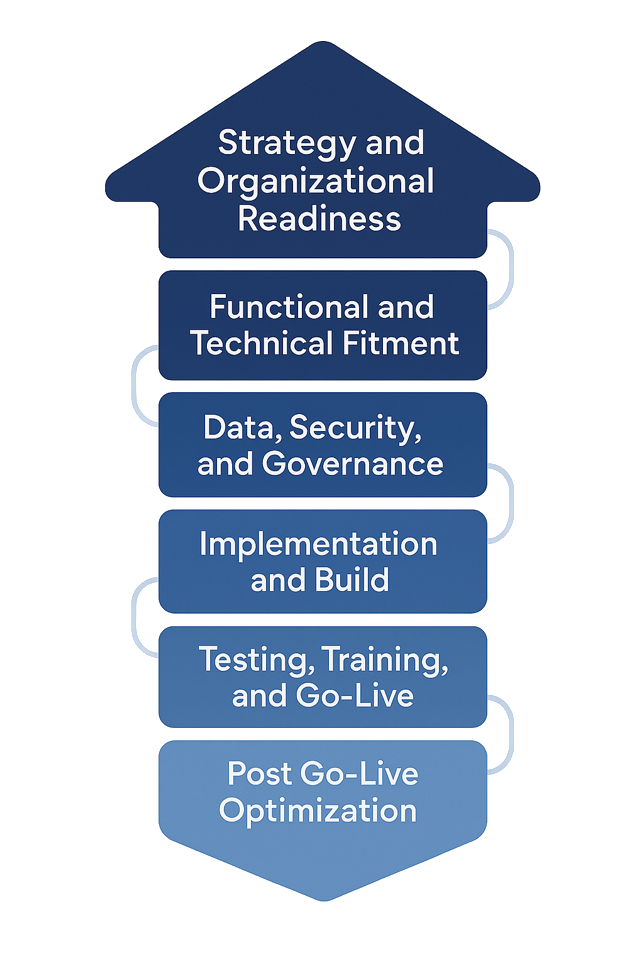
Phase 1: Strategy and Organizational Readiness
Every successful Dynamics 365 implementation starts with clarity at the business level.
The first step is to clearly define why the organization is implementing Dynamics 365. Business objectives should be specific and measurable. Vague goals such as “improving CRM” or “digitizing processes” often lead to misaligned expectations and scope creep. Instead, objectives should be tied to tangible outcomes such as improving sales forecast accuracy, reducing order processing time, increasing finance visibility, or standardizing reporting across regions.
Executive sponsorship is equally critical. A Dynamics 365 program requires a clearly identified business sponsor with decision-making authority. Without strong executive ownership, implementations tend to slow down, decisions get delayed, and adoption suffers after go-live.
Scope definition should be explicit from the outset. Organizations must decide which Dynamics 365 modules are in scope, what will be delivered in each phase, and what is intentionally excluded. A phased rollout strategy is often more effective than attempting to deliver everything at once, especially for large or complex organizations.
Change management should be planned early, not treated as an afterthought. Dynamics 365 introduces changes in how people work, make decisions, and interact with data. Identifying impacted roles, planning communication, and preparing users for new ways of working is essential for long-term success.
Phase 2: Functional and Technical Fitment
Once strategic alignment is established, the focus shifts to understanding how Dynamics 365 will support business processes.
Current-state processes should be documented in sufficient detail before configuration begins. This includes sales workflows, finance processes, approval structures, reporting needs, and integrations with other systems. Automating poorly designed processes only amplifies inefficiencies.
A critical decision point during this phase is determining what should be handled using standard Dynamics 365 functionality and where customization is genuinely required. Over-customization increases cost, complexity, and long-term maintenance risk. A configuration-first approach, supported by Power Platform where needed, typically provides the best balance between flexibility and sustainability.
Integration requirements must be clearly defined. This includes identifying upstream and downstream systems, data ownership, synchronization frequency, and error-handling mechanisms. Integration design should support business continuity and scalability, not just initial go-live.
Reporting and analytics requirements should also be addressed early. Leadership dashboards, operational reports, and forecasting models should be defined upfront so that data structures and configurations support meaningful insights from day one.
Phase 3: Data, Security, and Governance
Data quality and governance play a decisive role in the success of any Dynamics 365 implementation.
Clear data ownership must be established. Organizations should define who is responsible for customer data, financial data, and master records. Without ownership, data quality deteriorates quickly, reducing trust in the system.
Data migration should be treated as a business exercise, not just a technical task. Decisions must be made on what data to migrate, how much history is required, and how data will be cleansed and validated. Poor data quality is one of the fastest ways to undermine user confidence in a new system.
Security design should reflect organizational structure and compliance requirements. Role-based access must be carefully planned to ensure users see only what they need while maintaining appropriate controls.
Governance frameworks should define how changes are introduced, how environments are managed, and how releases are controlled. Strong governance does not slow delivery; it enables consistency and long-term stability.
Phase 4: Implementation and Build
The implementation phase is where strategy translates into execution.
Organizations must choose a delivery model that aligns with their risk profile and organizational maturity. Phased delivery is often more effective than a single large rollout, as it allows teams to learn, adapt, and course-correct.
The solution should be built with future scalability in mind. This includes planning for additional users, new business units, geographic expansion, and advanced capabilities such as AI and analytics. Short-term shortcuts often lead to long-term limitations.
Power Platform should be used strategically to extend Dynamics 365 functionality where required. Model-Driven Apps and automations can address specific business needs without introducing excessive custom code. However, extensions should remain aligned with governance standards to avoid creating disconnected solutions.
Even if AI features such as Copilot are not enabled immediately, the implementation should be designed with AI readiness in mind. Structured data, standardized processes, and clear security models are prerequisites for effective AI adoption.
Phase 5: Testing, Training, and Go-Live
Testing and adoption planning are as important as configuration and development.
User acceptance testing should be business-led and scenario-driven. Business users must validate that the system supports real-world use cases, not just technical functionality.
Training should be role-based and practical. Generic system overviews rarely drive adoption. Users should understand how Dynamics 365 helps them perform their specific roles more effectively.
Go-live should be carefully planned and controlled. Data validation, support readiness, and contingency planning must be in place. A defined hypercare period after go-live helps address early issues and builds user confidence.
Phase 6: Post Go-Live Optimization
Go-live is not the end of the implementation journey.
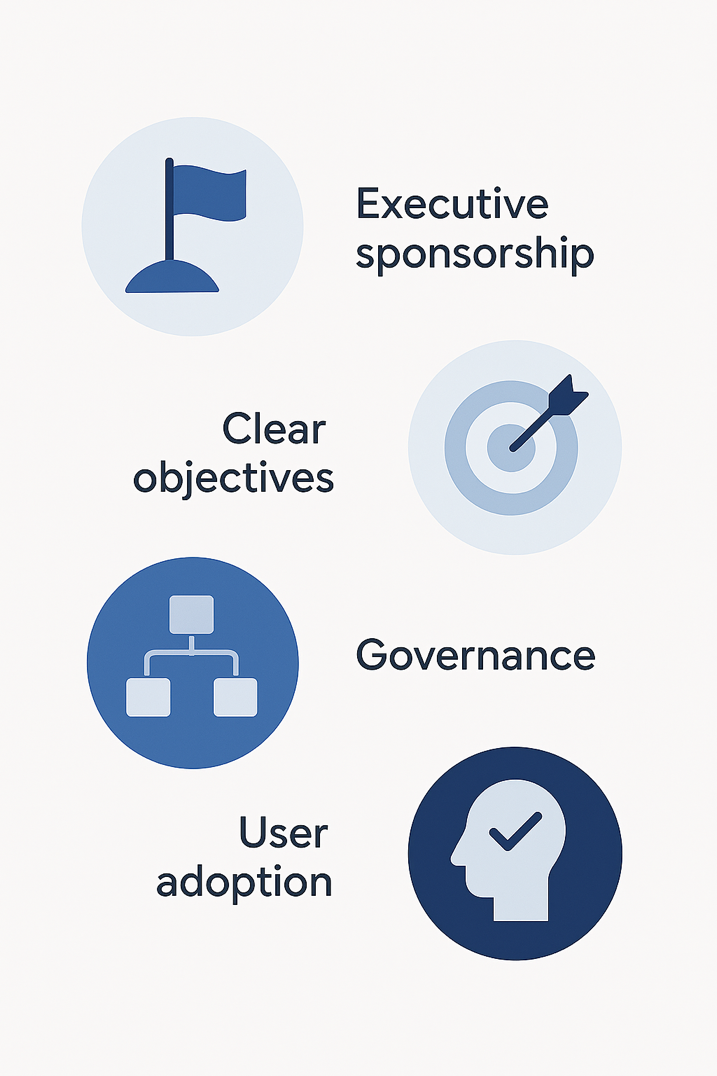
Oganizations should actively monitor system adoption using measurable indicators such as login frequency, data completeness, and feature usage. Low adoption usually indicates process or usability issues that need to be addressed.
Once the system stabilizes, advanced reporting and analytics can be introduced to deliver deeper insights to leadership and operational teams. This is often where organizations begin to see significant business value.
AI and Copilot capabilities should be introduced gradually. Starting with summaries, insights, and recommendations allows users to build trust before expanding usage.
A continuous improvement roadmap ensures that Dynamics 365 evolves with the business. Regular reviews and incremental enhancements help sustain value over time.
Common Implementation Mistakes to Avoid
Many Dynamics 365 implementations struggle due to avoidable mistakes. These include excessive customization, poor data quality, lack of ownership after go-live, treating the initiative as an IT project rather than a business transformation, and failing to plan for analytics and AI.
Avoiding these issues often has a greater impact on success than selecting specific features or modules.
Conclusion
A Dynamics 365 implementation is not a one-time technical exercise. It is a long-term transformation initiative that affects people, processes, and decision-making across the organization.
Organizations that succeed take a structured approach, invest in strong foundations, prioritize adoption, and plan for continuous improvement. When implemented thoughtfully, Dynamics 365 becomes a strategic platform that enables growth, visibility, and agility.
How Zelite Solutions Can Help
Zelite Solutions helps organizations implement Microsoft Dynamics 365 using a structured, outcome-driven approach. Our focus is on building solutions that deliver measurable business value, not just system deployments.
We work with clients across CRM, ERP, Power Platform, integrations, analytics, and AI to ensure Dynamics 365 supports long-term business objectives.