
The Gap That Digital Transformation Didn’t Close
Here’s a question worth sitting with: if your organization has spent the last decade digitizing everything — moving to the cloud, implementing ERP, deploying CRM, connecting your departments — why are critical decisions still slow, inconsistent, and disconnected from the data you generate every day?
That’s not a rhetorical question. It’s the problem most enterprise leaders are actually facing, even after years of digital transformation investment.
The reason is straightforward, if uncomfortable: digital transformation was never designed to transform decisions. It was designed to transform operations. Those are different problems.
That distinction is now the defining business challenge of 2026. Organizations that understand it are moving. Organizations that don’t are adding more tools to a system that was never designed to do what they need.
What ERP and CRM Were Actually Designed to Do
Digital transformation did what it was supposed to do. Processes became faster and more consistent. Data that lived in filing cabinets moved into dashboards. Teams that couldn’t talk to each other got collaboration tools. These are real achievements.
But the architecture of digital transformation had a fundamental design assumption baked in: humans make decisions, systems execute them. Every ERP, CRM, and workflow tool built in the last decade was designed around that assumption.
Systems surfaced data. Humans interpreted it. Humans decided. Systems recorded the outcome. That’s the loop that digital transformation optimized. It works until the volume of data exceeds what human teams can meaningfully process — which is now.
This model breaks down in four specific conditions:
- The volume of data exceeds what any team can meaningfully process
- Decision quality varies significantly across individuals and departments
- Business conditions change faster than reporting cycles can capture
- Strategic insights live in unstructured sources — emails, meetings, documents — that structured systems never touch
The result is an enterprise that is digitally mature but intelligence-constrained. You have data. You don’t yet have a system that reasons over it, learns from it, and acts on it faster than your competitors.
AI Transformation Is a Different Operating Model
AI transformation is not an upgrade to digital transformation. It’s asking a fundamentally different question.
Where digital transformation asked: “How do we digitize what we already do?”, AI transformation asks: “How do we make every decision in the organization smarter, faster, and more consistent?”
It requires connecting data, knowledge, governance, and AI agents in a way that allows intelligence — not just information — to flow across the organization. You might be wondering: how different is this really from what we’ve been doing? The honest answer is: substantially different. The technology overlaps. The architecture doesn’t.
The organizations moving fastest in 2026 are not those who purchased the most AI tools. They are those who built coherent intelligence architectures — where AI is embedded in how the business reasons, not just how it operates.
Three Phases of Enterprise Evolution
The evolution from digital transformation to AI transformation follows three distinct phases:
Phase 1 —
Digitization: Processes move from paper to digital. Data is captured. Systems of record are established. Value comes from consistency and accessibility.
Phase 2 —
Integration: Systems connect. Data flows between ERP, CRM, and analytics. Dashboards and reports surface insights. Value comes from visibility.
Phase 3 —
Intelligence: AI is embedded across systems. Decisions are augmented by models trained on enterprise data. Agents execute tasks autonomously within defined governance boundaries. Value comes from the quality and speed of decisions — at scale.
The architecture of an enterprise intelligence platform:
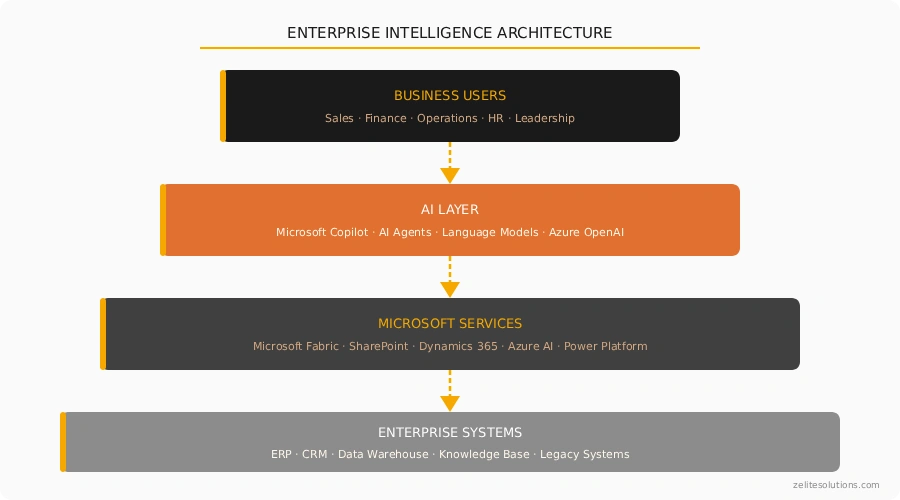
Each layer is necessary. None is sufficient on its own. The architecture is the differentiator.
What’s Already in Your Microsoft Investment
For organizations already invested in Microsoft, the foundation is more complete than most realize. The components are there. The question is whether they’ve been connected intentionally into an architecture that produces intelligence — rather than left as separate tools that produce data.
Microsoft Fabric + OneLake:
Provides a unified data platform that consolidates data from across the enterprise without requiring migration or duplication. Fabric becomes the intelligence backbone.
Microsoft Copilot:
Embeds AI across Microsoft 365, Dynamics 365, and Power Platform. Makes AI ambient — present at the moment every decision is made.
Dynamics 365:
Connects CRM and ERP data with AI capabilities, enabling intelligent sales forecasting, automated customer engagement, and real-time operational insights.
Copilot Studio + Azure AI:
Allow organizations to build custom AI agents for specific business processes — from lead qualification to invoice processing to internal knowledge retrieval.
SharePoint as Enterprise Knowledge Layer:
Transforms document repositories into searchable, AI-accessible knowledge assets that agents can query in real time.
What Changes — Specifically
When organizations make this shift, the outcomes are measurable and genuinely distinct from what digital transformation delivered.
- Decision speed increases. When AI surfaces relevant data at the moment of decision — rather than waiting for a reporting cycle — leaders act faster and with greater confidence. Decisions that used to wait for the Monday review happen on Tuesday afternoon.
- Decision quality becomes consistent. AI-augmented decisions follow the same reasoning logic regardless of who is involved. The expertise gap between your best analyst and your newest hire narrows significantly.
- Knowledge stops being locked. Institutional knowledge embedded in documents, emails, and past project work becomes accessible to every team member and AI agent simultaneously — not just the people who were in the room when decisions were made.
- Operations become anticipatory. Rather than responding to what happened, organizations start predicting what’s about to happen — in inventory, in sales pipelines, in customer churn. The shift from reactive to predictive is where significant efficiency gains appear.
- Cost of routine cognitive work drops. Tasks that required human judgment — drafting communications, summarizing contracts, classifying support tickets — are handled autonomously within defined governance boundaries. Human capacity goes to work that genuinely requires it.
These are not incremental improvements to what digital transformation delivered. They are a different category of value — and they require a different kind of investment to unlock.
The Honest Answer to What AI Transformation Requires
At Zelite, we work with organizations that have already made substantial investments in digital transformation and are now asking the right next question: “What do we actually need to do to make AI deliver measurable business outcomes?”
The honest answer: it’s rarely about buying more technology. It’s about building the right architecture — connecting data, knowledge, AI services, and governance in a way that allows intelligence to flow to where decisions are actually made. Most organizations have most of the components. They haven’t connected them. That’s the gap we work in.
We bring together deep expertise across Fabric, Copilot, Dynamics 365, and Azure AI with a structured approach to readiness assessment and architecture design. Our role isn’t to add AI on top of your existing systems — it’s to help you redesign the intelligence layer that sits above them.
The organizations that will lead in the next five years are not those with the most AI tools. They are those who build intelligence as a strategic capability. If you’re serious about that, we should talk.