


Spending More, Knowing Less
Here is a pattern that repeats across almost every industry right now: a company has spent real money on AI — Copilot licenses, a chatbot pilot, maybe a data science proof-of-concept — and the executive team still cannot tell you what AI is actually doing for the business. Not because the tools do not work, but because no one decided what they were supposed to accomplish.
The result is a collection of experiments that look busy but produce nothing coherent. Each project has a sponsor, a budget, and an enthusiastic launch. Almost none of them have a strategy connecting them to something the business actually cares about measuring.
Why Starting With Tools Is the Wrong MoveTools Without Direction Just Create Faster Chaos
The temptation to start with tools is understandable. Vendors make AI remarkably easy to activate. Pilots move fast. Early demos look genuinely impressive. But when every department acquires AI capability without a shared direction, what you end up with is not intelligence — it is fragmentation with a better interface.
The tell is simple: if your organization cannot answer three questions — which AI investments create the most business value, how AI capability connects across departments, and what governance keeps AI operating safely — then you have tools, not a strategy. And tools without strategy will not compound. They will compete.
What the Organizations Getting It Right Are Doing DifferentlyStrategy First, Then Technology
The companies generating real value from AI are not necessarily the ones with the most tools or the biggest budgets. They are the ones who decided what they were building toward before they started buying. They defined what AI should deliver for their specific business, which outcomes they were working toward, and how every investment connected to that destination.
This is worth saying plainly: an AI strategy is not a technology plan. It is a business capability plan — one that happens to be enabled by technology. Getting that framing right changes everything about how AI investments get prioritized, measured, and built upon.
What a Mature AI Strategy Actually Looks LikeFour Layers, One Connected System
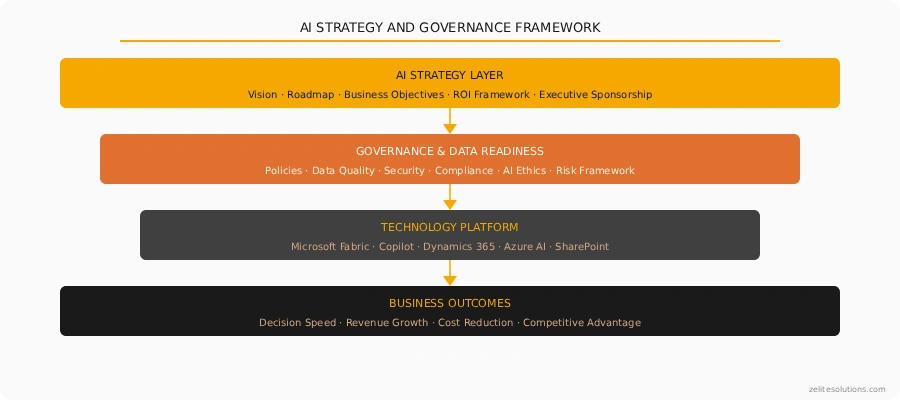
A mature AI strategy connects four layers: the business outcomes at the top, governance and data readiness in the middle, and the technology platform at the base. The direction of travel is top-down — outcomes define what data must be available, which in turn shapes the platform choices. Most organizations build this in reverse, starting with platform and hoping outcomes follow.
Where Microsoft Fits In
The Platform Follows the Strategy — Not the Other Way Around
Microsoft’s platform is genuinely capable of executing a well-designed AI strategy. Fabric handles data readiness. Copilot handles everyday AI adoption. Copilot Studio handles process-specific agents. Azure AI Foundry handles proprietary model development. Purview handles governance. Each component has a clear role — but only once the strategy has defined what role it is supposed to play.
The components deployed without the strategy are just licensing costs. That is worth sitting with for a moment if your organization has already bought licenses without a clear roadmap for what they are building.
What Changes When You Have a StrategyAI Investments That Work Together Instead of Competing
Organizations with a coherent AI strategy stop making isolated investments and start building a compounding capability. Resources flow to use cases with the highest return. Governance gets built before problems require it. And for the first time, someone in the room can answer the question: what is AI actually doing for us?
- Decisions get made faster across every business function — with better information behind them
- AI investments reinforce each other rather than fragmenting into separate silos
- Governance enables AI to scale rather than becoming the reason it cannot
- Leadership gets a defensible story for the board about AI as a strategic capability — not a series of experiments
Honest Answers Before Tool Recommendations
The question we get asked most often — at the start of almost every engagement — is: which AI tool should we start with? And our honest answer is always: that is the second question. The first question is what you are trying to accomplish, and for whom, and how you will know if it is working. We do not start with tool selection. We start with those three questions.
An AI strategy built before the budget is committed is worth more than any single tool. That is not a philosophical position — it is just what we have seen in practice.Start With the Right Question
If your organization has AI spend but cannot clearly answer what it is building toward, that is the conversation worth having. Not about tools — about strategy. We have had that conversation with enough teams to know it changes how everything else gets prioritized.