
You Have Copilot. Now What?
Copilot has done something remarkable: it made AI adoption feel achievable for enterprises that had been skeptical for years. Licensing is accelerating, users are actually using it, and the productivity gains are real. But there is a trap forming. Organizations that declare Copilot as their AI strategy are confusing a product with a plan — and they are going to find out the hard way that productivity and intelligence are not the same thing.
The Productivity CeilingWhen Copilot Is the Whole Story
Deployed on its own, Copilot makes individuals faster. It drafts emails, summarizes meetings, finds documents. These are real benefits and worth having. But they are productivity gains at the individual level — not intelligence gains at the organizational level. The question nobody seems to be asking loudly enough is: when Copilot drafts that email, what data is it drawing on? From what source? How current? How governed?
The Stack That Makes Copilot Actually IntelligentAgents, Fabric, Foundry — the Layers Most Organizations Are Not Using
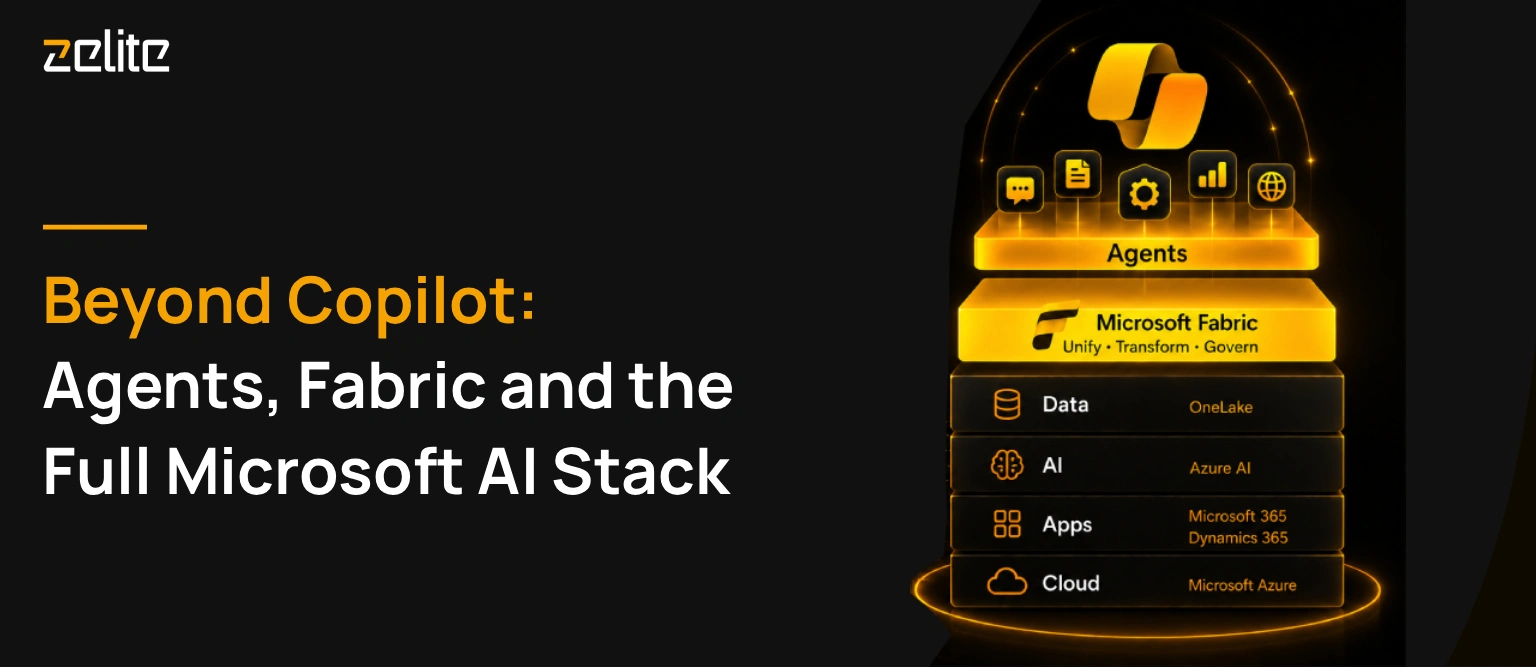
The full Microsoft AI stack goes well beyond Copilot. Custom and built-in agents deployed through Copilot Studio handle specific business processes autonomously. Microsoft Fabric provides the unified data foundation that grounds everything in accurate, governed information. Azure AI Foundry enables organizations to build proprietary AI capabilities that no vendor sells off the shelf. Most organizations using Copilot have activated maybe fifteen percent of this picture.
Seeing the Full StackHow Copilot, Agents, and Fabric Connect
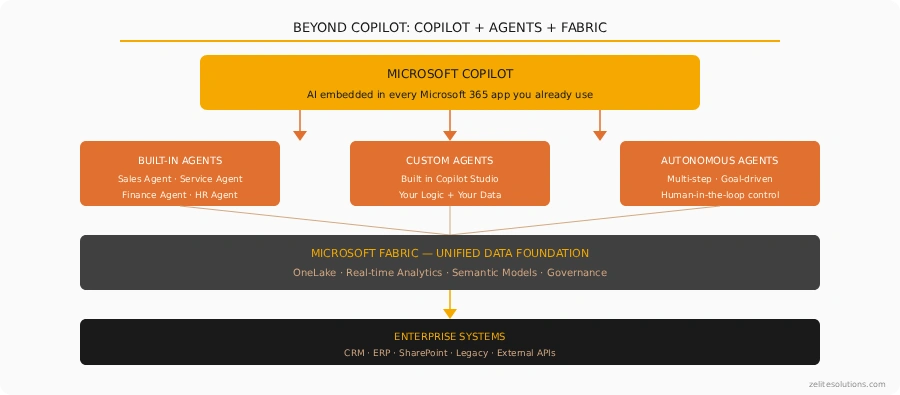
Copilot sits at the top of a much richer architecture. Below it is a layer of agents — both Microsoft’s built-in agents for sales, service, finance, and HR, and custom agents that encode your specific business logic. Below that is Microsoft Fabric: a unified data foundation that gives every agent and every Copilot interaction access to the same accurate, current enterprise data. The architecture is designed to compound. Most deployments stop at the first layer.
 What Each Layer Actually Contributes
Breaking Down the Stack
Copilot brings AI into every tool employees already use. Built-in agents handle specific tasks — sales follow-ups, service routing, financial reconciliation — without waiting for human instruction. Custom agents built in Copilot Studio are the most underused and undervalued part of the stack. They encode your organization’s specific business logic, your processes, your language, your exceptions. Microsoft Fabric is what makes all of it trustworthy: a unified data layer so that no agent or Copilot interaction is reasoning over stale or incomplete information.
Why the Combination MattersValue That Grows As the Layers Connect
When the full stack operates together, something changes. Copilot responses get noticeably more useful because they are grounded in Fabric data rather than whatever happens to be cached. Agents become reliable enough to trust with real business processes because they are drawing from the same unified source. Custom agents encode logic that generic tools simply cannot replicate. And the proprietary capabilities built on Foundry cannot be bought by a competitor from any Microsoft price list. That last point is underappreciated.
Where Most Organizations Are Right NowDesigning the Architecture From Day One
The organizations we see getting the most from Microsoft AI are not the ones with the most Copilot seats — they are the ones who designed the full stack from the beginning. Copilot adoption happened in the context of an agent roadmap and a Fabric data strategy, not as a standalone project. That sequence matters enormously. Retrofitting architecture onto an already-deployed tool is expensive and disruptive. Getting the design right before the licensing conversations happen saves significant time and money downstream.
If You Have Copilot But No Roadmap for What Comes Next
Copilot is the beginning. Agents, Fabric, and Foundry are where the differentiated value actually lives. If your organization has activated Copilot but has not yet planned the next three layers, you are not behind — but the gap between you and the organizations that have will grow quickly.