


The Microsoft Ecosystem Problem Nobody Wants to Name
If you mapped the Microsoft products running in a typical mid-sized enterprise, you would find something interesting: Dynamics 365 managed by the CRM team, SharePoint managed by IT, Fabric sitting in a separate data initiative, and Copilot rolled out by whoever owns Microsoft 365. Each component is genuinely good at what it does. None of them know the others exist.
This is not a technology failure — it is an organizational one. Companies buy Microsoft products in functional silos and deploy them that way. The result is a portfolio that could be transformational but instead produces smarter silos. Better interfaces, same fragmentation.
When Integration Is an AfterthoughtDeploying Each Product as Its Own Project
The pattern we see repeatedly: Dynamics 365 launched as a CRM project with its own timeline and success metrics. SharePoint modernized as an intranet initiative. Copilot rolled out as a productivity program. Each delivered something. None of them could answer the question that actually matters to senior leadership: given everything we know about this customer, this deal, and this market — what should we do next? That question requires all four components talking to each other. Almost no one has built that.
The Organizations That Have Built the ConnectionIntegration Is Where the Value Actually Lives
The companies extracting the most from the Microsoft ecosystem have done something most have not: they treated integration as the goal, not an afterthought. Dynamics customer data enriches Copilot responses so they are actually relevant to the account in front of you. SharePoint knowledge makes agents accurate instead of generic. Fabric gives every component access to the same unified data — so finance and sales and operations are no longer working from three different versions of reality.
What the Connected Architecture Looks LikeOne Unified System, Not Four Separate Products
In the connected architecture, Fabric serves as the shared data layer — the single source of truth that every other component draws from. Copilot becomes the intelligence interface that every employee uses, grounded in data from all connected systems. Dynamics provides the structured operational record. SharePoint provides the institutional knowledge. When these connect through Fabric, Copilot can finally give a genuinely useful, context-rich answer instead of a generic AI response.
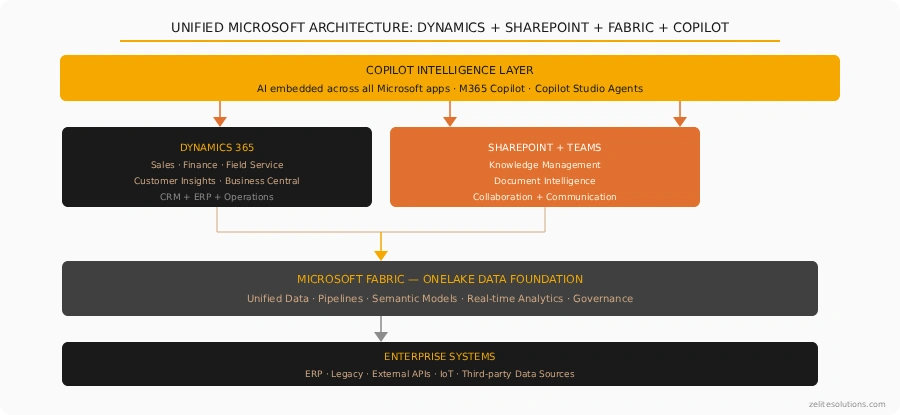 What Each Component Actually Contributes
Understanding the Role of Each Layer
Dynamics 365 is the structured record of how the business operates — customer data, sales history, financials, operational transactions. SharePoint is the accumulated organizational knowledge — policies, playbooks, institutional memory, the things people know but never put in a database. Fabric unifies both into a single AI-accessible layer. And Copilot makes the combined intelligence available to every employee at the moment they need it — not in a separate analytics portal that no one opens, but in Teams, in Outlook, in the tools they are already using.
The Outcomes That Only Integration Can DeliverWhat Changes When All Four Components Work Together
This is where the outcomes get genuinely interesting, because none of these are possible from any single component in isolation.
- A sales rep who can see account history, relevant internal knowledge articles, and an AI-generated next-best-action recommendation — all in one Copilot interface, without switching between four systems
- Finance leaders who see pipeline data alongside actual ERP numbers in real time — not two reports that were generated at different times from different sources
- Operations teams who can ask natural language questions and get answers that cross Dynamics and SharePoint data simultaneously
- Leadership that has a single unified view of the business — no more reconciliation, no more ‘which report should we trust’
Integration Architecture Requires Different Expertise
The reason most Microsoft deployments stop at the component level is not technical — the components are genuinely designed to connect. The reason is organizational and architectural: integration requires someone who understands how all four components should work together, not just how each one works individually. Zelite has delivered this architecture across multiple industries. The value unlocked from the Microsoft investment clients already have is consistently higher than expected — because the components were already there, just not connected.
If Your Microsoft Products Are Not Talking to Each Other
Most organizations we talk to have already invested heavily in Dynamics, SharePoint, and Microsoft 365. They are not getting the return they expected — not because the products are underperforming, but because the connections have not been built. That is a much faster fix than it sounds.