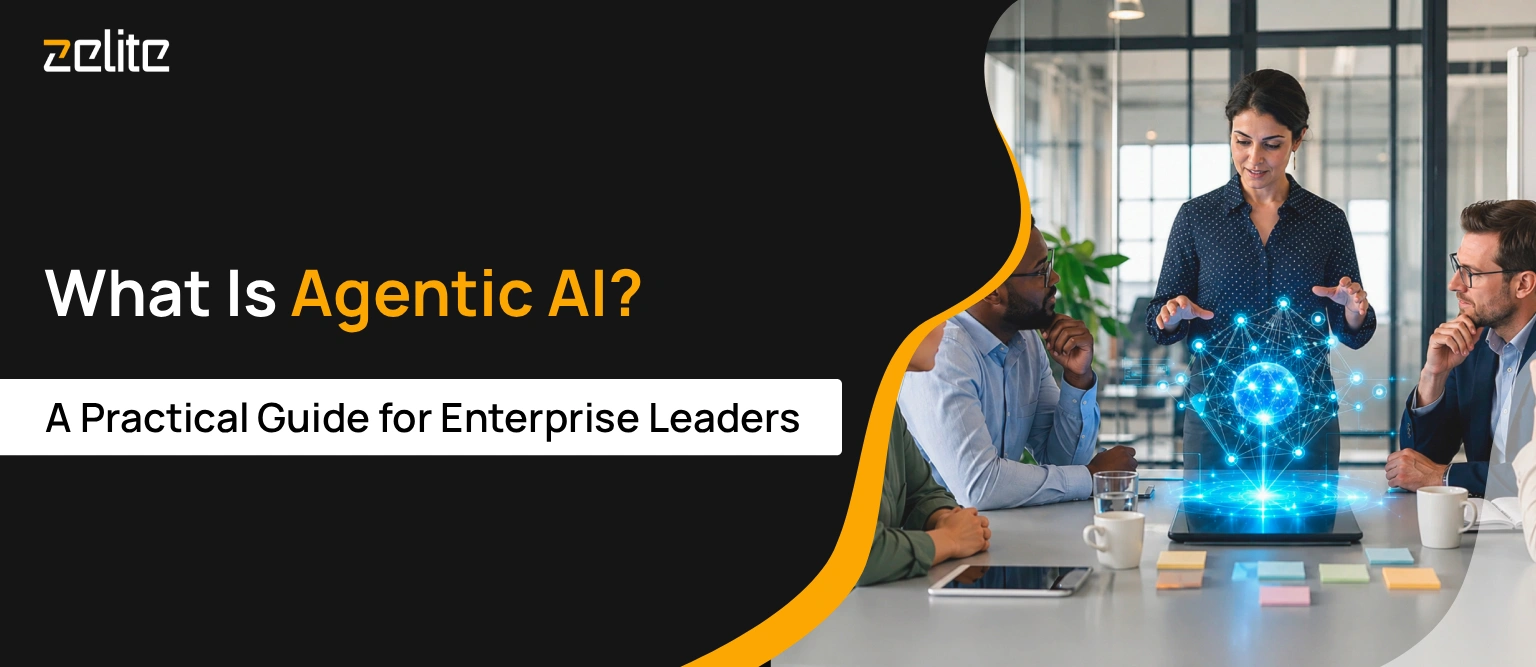

What Agentic AI Actually Means in Practice
Agentic AI has become one of those terms that every vendor uses and almost no one defines. It appears in every conference keynote, every analyst report, every product launch. And yet, in most enterprise conversations, the minute someone asks what it actually does — how it works, what it replaces, what governance it requires — the room gets quieter. This piece is an attempt to answer those questions directly, without the hype.
The goal here is not to sell you on agentic AI. It is to give you a clear enough understanding of what it is and is not that you can evaluate it honestly for your own situation.
The Limitation of AI That Waits to Be AskedReactive AI Requires Constant Human Initiation
Most enterprise AI deployed today is reactive. It responds when you prompt it. It answers when you ask. It generates when you instruct. This is valuable — genuinely. But it has a ceiling: every output requires a human to initiate the task, review the result, and then take action based on it. The AI is a tool. You are still the agent.
Agentic AI changes this model. Instead of waiting to be asked, agents are given goals and pursue them autonomously — through multi-step reasoning, decision-making, and action — without requiring a human at every step in the chain.
What Agentic AI Actually DoesFrom Answering to Acting
The defining characteristic of agentic AI is autonomous multi-step task completion. Consider a concrete example: rather than answering the question ‘what are our top ten accounts by revenue at risk of churn?’ — an agentic AI system can identify those accounts, analyze the signals suggesting churn risk, draft personalized outreach emails, schedule the follow-ups in the CRM, and flag the highest-risk cases for human review. All of that happens within a single goal-directed execution cycle. The human set the goal. The agent executed the plan.
This is not a theoretical future capability. This is what Microsoft Copilot Studio enables in production today. The gap between knowing this and having it deployed is architecture and governance — not technology availability.
How Agents Work TogetherMulti-Agent Systems: Orchestration and Specialization
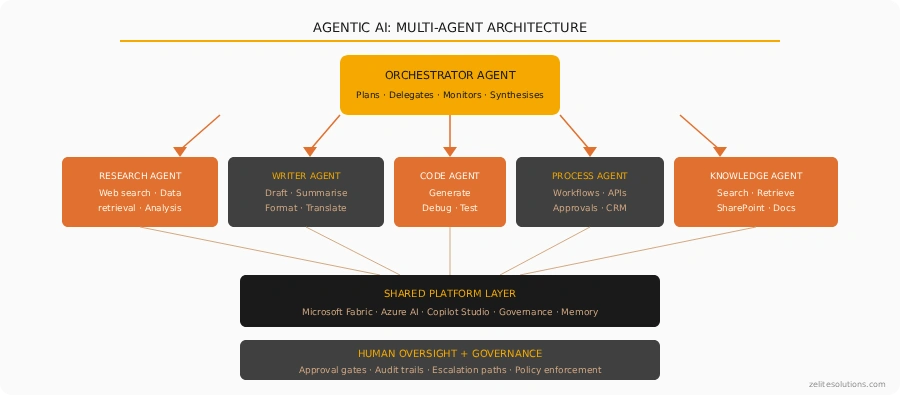
In more complex agentic systems, an orchestrator agent handles the planning and delegation — breaking a goal into sub-tasks and assigning them to specialized agents. One agent might handle research. Another handles writing. Another handles process execution. Another retrieves knowledge. Another generates and validates code. Each agent focuses on its domain. The orchestrator synthesizes the results into a coherent outcome. This is why agentic AI can handle tasks that would previously have required a team of people.
Where Microsoft Makes This DeployableThe Microsoft Agentic AI Platform
Microsoft Copilot Studio is the primary platform for building and deploying enterprise AI agents. The key word is enterprise — these agents are not consumer chatbots. They connect to Dynamics 365 for operational data, SharePoint for institutional knowledge, Fabric for analytical context, and external systems through a broad connector ecosystem. Microsoft also ships built-in agents for common functions — sales, service, finance, HR — that provide tested starting points. Custom agents built on top of these encode the specific logic, data, and governance rules of your organization. That customization is where the differentiated value actually lives.
What Changes When Agents Are RunningThe Practical Business Difference
- Tasks that previously took people hours can run autonomously in minutes — not because AI is faster at typing, but because the multi-step reasoning and action happen without handoffs between humans
- Processes that previously ran sequentially can run in parallel across multiple specialized agents simultaneously
- Institutional knowledge locked in documents becomes accessible in real time by knowledge-retrieval agents rather than requiring someone to search for it
- CRM and system updates happen automatically as agents process information — rather than requiring manual data entry after the fact
- Human attention gets redirected from routine execution toward judgment and relationships — the work that actually benefits from a human being in the loop
Governance and Scope Are Not Optional
Here is something we have learned from building agentic AI systems in production: the agents that fail usually fail not because the technology does not work, but because the scope was not defined clearly enough. An agent that can do anything tends to do nothing reliably. Every agent we build has a defined scope, a governance boundary, a measurable outcome target, and an explicit path for escalating to a human when the agent reaches the edge of its authority. That discipline is not a constraint on what agents can do. It is what makes them trustworthy enough to actually deploy.
If You Are Still Figuring Out What Agentic AI Means for Your Organization
That is an honest starting point — most organizations are. The most useful next step is usually a concrete conversation about two or three specific processes where autonomous multi-step execution would create clear value. If you know what those processes are, we can tell you what an agent for that use case would actually look like.