


AI Has a Distribution Problem
Most AI Is Still Concentrated in Two Places -Nowhere Near the Real Value
Ask people where AI is deployed in their organization and you’ll hear two answers more often than anything else: marketing, for content and campaign work, and IT, for code assistance and helpdesk. Those are real use cases. But they’re also the lowest-hanging fruit — and they’re nowhere near where the most significant business value sits.
The departments that arguably need intelligence most — finance, operations, procurement, HR, legal — are often the furthest from meaningful AI adoption. Not because AI can’t help them. It absolutely can. The AI conversation just hasn’t reached them in a form they can act on.
Generic AI Doesn’t Create Competitive Advantage
Horizontal AI Doesn’t Differentiate Anyone
Here’s the uncomfortable truth about generic AI tools: if you can buy it, so can every competitor. Content generation, productivity assistance, general chatbots — these create value, but not differentiation. The organizations that create lasting advantage from AI are deploying it vertically: purpose-built for specific functions, connected to function-specific data, and governed by function-specific rules that reflect how that department actually works.
One Agent Per Function
What It Looks Like When AI Reaches Every Function
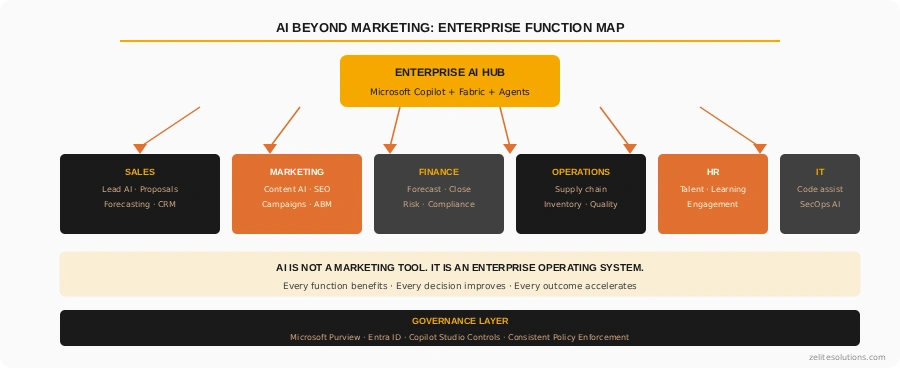
How Cross-Functional AI Actually Works
Building Intelligence That’s Actually Function-Specific
The architecture that makes cross-functional AI work has three layers. A shared data and governance layer — Microsoft Fabric and Purview — that ensures every agent is working from consistent, governed data. A shared agent platform — Copilot Studio — so each new function doesn’t require building a new infrastructure. And function-specific agents that encode the actual rules, data, and workflows of each department. The shared layers are what make this efficient. You build the infrastructure once, then customize for each function.
The Microsoft Stack Across Every Function
The Microsoft Stack — and Where Each Tool Actually Fits
Dynamics 365 provides the operational data for sales, finance, service, and field operations. SharePoint provides the knowledge layer accessible to every function. Fabric unifies data across all functions without duplication. Copilot makes AI ambient in every function’s daily tools. Copilot Studio enables function-specific agents without requiring each function to build its own infrastructure.
What Changes When Every Function Gets AI
What Happens Across the Business When AI Finally Spreads
- Sales: AI-drafted proposals, intelligent lead scoring, always-current CRM records without manual entry
- Finance: automated reconciliation, real-time cash position visibility, exception-based human review
- Operations: inventory agents preventing stockouts, procurement agents optimizing vendor selection
- Customer Service: instant resolution of routine queries, context-rich escalation to human agents
- HR: AI-screened candidates, personalized learning recommendations, instant policy query responses
- Legal: contract clause review, compliance monitoring, regulatory change alerts
Why We Build for the Whole Enterprise, Not One Department
We Build Across Functions Because That’s Where the Compound Value Lives
We don’t build AI agents for one department and walk away. We design them as part of a coherent cross-functional architecture — because that’s where the real compound value comes from. Every function agent we add to a shared platform makes the whole system smarter. Shared data, shared governance, compounding return. The pushback we hear most often is: “We just want to start in sales — we don’t need an enterprise architecture.” That’s fair. But if you build sales AI on its own foundation, expanding to operations later means starting over. Building on a shared foundation once is always cheaper than rebuilding it twice.
Which Function Is Your Highest-Value Starting Point?
Find the Function That Delivers the Most ROI First
Which function in your business would change the most if AI handled the routine cognitive work? That’s usually the right place to start. Zelite can identify it, design the agent architecture, and have a working agent in your environment within 6–8 weeks.