

The Paralysis Problem
Why the Best-Resourced Organizations Are Often Moving the Slowest
Here is a pattern that should not make sense but keeps appearing: the organizations with the most resources, the most sophisticated leadership teams, and the most AI-aware boards are often the ones moving slowest on actual AI adoption. Boards demand progress. Competitors are investing. Employees are experimenting with consumer AI tools regardless of what IT policy says. And the executive team is still waiting for the readiness assessment to be completed before anything gets deployed.
The AI transformation conversation too often jumps immediately to data governance frameworks, multi-year roadmaps, and enterprise architecture reviews. Those things matter — eventually. But they are not where most organizations should start, and treating them as prerequisites guarantees that nothing happens.
The Most Common Mistake in AI Adoption
Trying to Transform Everything Before Doing Anything
The boil-the-ocean approach — commissioning a comprehensive AI strategy, conducting full readiness assessments, designing the target architecture — consistently delays actual adoption by months or years while producing documents rather than value. The organizations generating the most AI value are not the ones with the most thorough upfront planning. They are the ones who identified a clear, narrow use case, deployed something against it, measured the result, and built from there.
The organizations that move fastest on AI do not have simpler strategies. They have a bias toward deployment over planning — and they build the strategy from evidence rather than trying to predict it in advance.
What the Right Starting Point Actually Looks Like
Quick Wins That Create the Organizational Confidence to Go Further
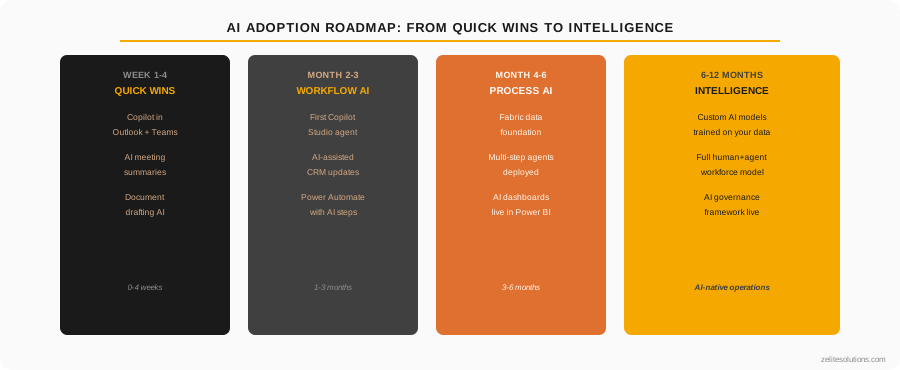
The roadmap is not a prescription — it is a pattern we have seen work repeatedly. Organizations move from quick wins (Copilot in Teams and Outlook, AI-generated meeting summaries) to workflow AI (first agent, CRM assistance) to process AI (Fabric data foundation, Power BI) to full intelligence (custom models, redesigned workflows). The key insight is that each stage creates the organizational confidence, the data literacy, and the business case that enables the next one. You cannot skip to stage four. But you can reach it much faster than most organizations expect if you start stage one quickly.
Start With What Is Already There
Most Organizations Have the Foundation and Do Not Realize It
Most mid-sized organizations already have Microsoft 365 licenses. That means Copilot is one activation step away from being in the hands of every employee. Starting with Copilot in Teams and Outlook is not a concession to simplicity — it is a strategically sound move. It builds AI literacy across the workforce. It generates measurable productivity data that supports the next investment conversation. And it demonstrates to skeptical employees that AI actually works in their daily work, which matters more than any executive mandate for building a culture that can absorb deeper AI adoption.
What Microsoft Has Made Accessible
The Barrier to Early Value Is Lower Than Most Leaders Think
Microsoft has genuinely lowered the barrier to early AI adoption. Copilot in Microsoft 365 requires only license activation — no infrastructure build, no data migration, no integration project. Power Automate AI actions are already included in existing licenses for most organizations. Copilot Studio enables first agents with limited technical overhead. The most common objection we hear — ‘we are not ready yet’ — is usually not a data readiness problem or a governance problem. It is a decision problem. And those are easier to solve than infrastructure problems.
What Quick Wins Actually Produce
Concrete Outcomes in Weeks, Not Months
- AI-generated meeting summaries and action items — immediate time recovery for every employee who attends more than three meetings a week, which in most organizations is almost everyone
- AI-drafted emails and documents — measurable productivity gains that show up in usage data within days of activation, not months
- A first AI agent handling routine queries — visible, concrete automation that gives leadership a real example to point to and employees a real experience of AI working for them
- AI-enhanced CRM records — data quality that improves from day one and compounds over time as the system learns what accurate data looks like
- Organizational AI confidence — worth calling out separately because it is the most important foundation for every subsequent investment. Teams that have seen AI work in their actual workflow are dramatically more ready to adopt deeper capabilities.
What We Actually Do in the First Phase
Value First, Architecture Second
Zelite helps organizations identify the three highest-value quick wins for their specific situation — not generic AI use cases but the specific workflows where rapid deployment will produce the clearest, fastest return. We activate them within weeks. We measure the outcomes. And we use those outcomes to build the business case for the next phase of investment. We do not start with architecture. We start with a concrete win that generates evidence. The architecture follows the evidence — which makes every subsequent decision much easier to justify.
The organizations that wait until everything is ready before doing anything will find that everything is never quite ready. The organizations that deploy something quickly and learn from it are already three steps ahead.
What Would Your First AI Quick Win Actually Be?
That question sounds simple but is genuinely worth thinking through. If you are not sure, we can help you identify the specific use cases that will produce the clearest, fastest value for your organization — and build the roadmap from that first win to something much more significant.