

Why the Best-Resourced Organizations Are Often Moving the Slowest
Here is a pattern that should not make sense but keeps appearing: the organizations with the most resources, the most sophisticated leadership teams, and the most AI-aware boards are often the ones moving slowest on actual AI adoption. Boards demand progress. Competitors are investing. Employees are experimenting with consumer AI tools regardless of what IT policy says. And the executive team is still waiting for the readiness assessment to be completed before anything gets deployed.
The gap is not mainly about technology skills — though those matter. It is about the accumulation of delivered AI outcomes and the organizational muscle that comes from having done this work repeatedly with real clients.
Why Certifications and Marketing Language Are Not EnoughAn AI Practice Is Not a Badge or a Press Release
The most common response we see from partners who recognize they are behind is to pursue Microsoft AI certifications, attend partner events, and add AI language to their marketing collateral. These actions are not wrong. But they do not constitute an AI practice. They signal awareness. They do not demonstrate capability.
An actual AI practice requires delivered client AI projects with documented outcomes. A methodology for AI readiness assessment and architecture design. Technical teams with real deployment experience. And a commercial model built around AI outcomes rather than AI implementations. Clients who have worked with genuine AI practices know the difference immediately.
How Maturity Is Actually Distributed in the MarketThe Partner AI Maturity Model
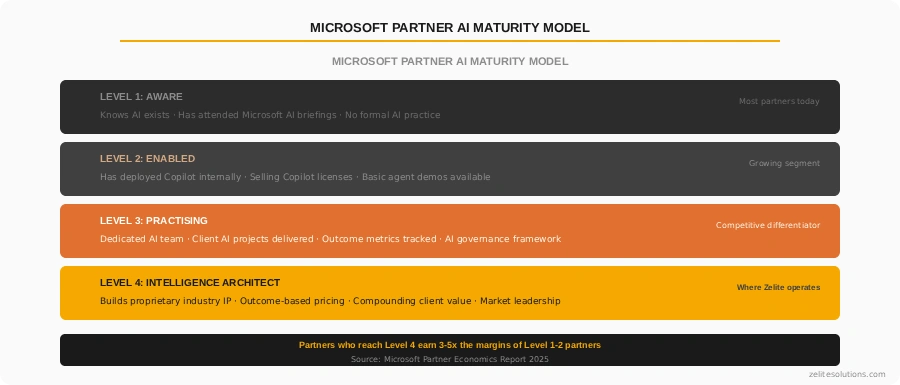
Partners at Level 4 — Intelligence Architects — are earning 3-5x the margins of Level 1-2 partners on comparable engagements. That number is worth sitting with. The value is not in the Microsoft license. The license is the floor. The value is in the architecture, the methodology, and the delivered track record built on top of it. Most of the margin in this market is concentrating rapidly in the partners who have invested in genuine capability.
What Building a Real AI Practice RequiresCapability Across the Full Stack
Building a real AI practice means developing capability across all four layers of the Microsoft AI stack: Fabric for data architecture, Copilot for adoption and change management, Copilot Studio for agent design and deployment, and Azure AI Foundry for proprietary model development. Partners who cover only one or two layers — typically Copilot and maybe some Fabric — are not yet operating as an AI practice. They are operating as a product specialist, which is a different and less defensible market position. What Microsoft Has Made Available to PartnersResources That Most Partners Are Not Using
Microsoft has invested significantly in enabling partner AI capability: the AI Cloud Partner Program, dedicated AI partner support, co-sell opportunities for AI solutions, and Azure credits specifically for AI development. The honest observation is that most partners who describe themselves as AI-focused have not fully activated these programs. They are leaving both capability-building resources and co-sell pipeline on the table. That is worth fixing quickly, before the partners who have activated them build an insurmountable lead.
What AI Practice Partners Actually EarnThe Business Case for the Investment
- Higher margin engagements — because clients pay meaningfully more for architecture and outcomes than for implementation and configuration
- Longer-duration relationships — because outcome-based partnerships are structurally stickier than project-based delivery
- Proprietary IP that genuinely differentiates the practice from commodity competitors who are selling the same Microsoft licenses
- Microsoft co-sell eligibility for AI-specific solutions — which generates qualified pipeline directly from Microsoft field teams
Two Years of Deliberate Investment
Zelite built its AI practice through deliberate investment over two years — not as a side project, but as the primary strategic commitment. We have delivered AI projects across sales, finance, operations, and customer service. We have proprietary capabilities built on Azure AI Foundry that are not available from any other partner. We have an AI readiness methodology developed across real client engagements — refined by what worked and what did not. We did not arrive here quickly. But we are now well positioned as the market accelerates — and the partners who start this work today will be where we are in two years.
The partners who wait another year to start will be further behind than they are now.
Where Is Your Practice on the AI Maturity Model?
If you are a Microsoft partner and are not sure how to answer that question honestly, that is a useful starting point. We can help you assess where you are, identify the fastest path to a credible AI practice, and figure out whether building independently or collaborating with a more mature AI practice is the right call.