


Hours Times Rates No Longer Works
For decades, technology services revenue has had a deceptively simple structure: clients pay for time, partners deliver work. Hours multiplied by rates equals revenue. The model was comfortable. It was also always slightly perverse — partners earned more when projects were slow and complex, and less when they were efficient and fast. AI is now making that perversity impossible to ignore.
AI compresses the effort required to deliver the same outcome. It does not compress the outcome — it makes reaching it faster. In a time-based billing model, that means the partner who becomes more efficient earns less money for the same result. That incentive structure cannot survive in a market where clients are now asking ‘what business outcome will this deliver?’ rather than ‘how many hours will it take?
The Problem With Billing for Hours in 2025
A Commercial Model That Rewards the Wrong Things
The effort-based model creates an incentive misalignment that clients are increasingly unwilling to fund. Partners earn more when projects are complicated and slow. Every efficiency improvement in delivery reduces revenue. There is no commercial reason for a time-billed partner to optimize for speed — and every client in the room understands this, even if nobody says it out loud.
The client-side shift is just as significant. Leaders who used to ask ‘how many hours will this take?’ are now asking ‘what will this actually change in our business, and how soon?’ These are not variations of the same question. They are different conversations requiring different partners.
The Four Phases of How This Market Is Evolving
Where the Industry Is Heading
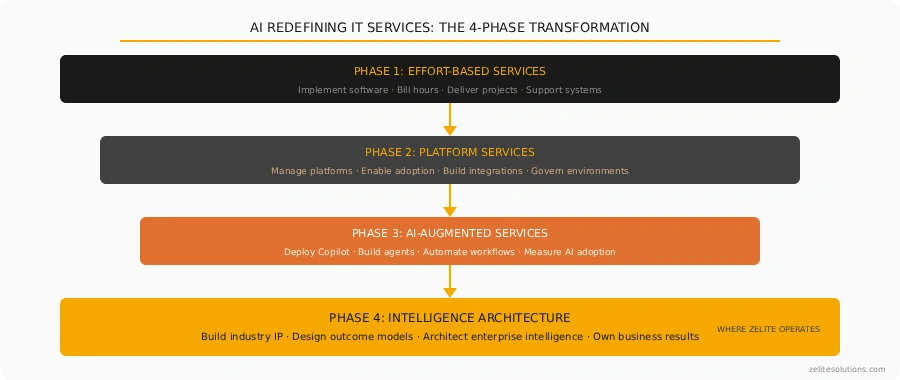
The most advanced partners are already operating at Phase 4: intelligence architecture. They price against business outcomes. They build proprietary capabilities. They measure success by how much smarter and more capable their clients become over time — not by how many projects they delivered on budget. That is a fundamentally different engagement model, and clients who have experienced it rarely want to go back.
What Outcome-Based Engagements Actually Require
Harder Upfront Conversations, Better Long-Term Results
Moving from effort-based to outcome-based requires a different kind of discipline at the start of every engagement. Outcomes have to be defined clearly — not as vague aspirations but as specific, measurable results. The architecture has to be designed to deliver those specific outcomes. Measurement frameworks have to track them continuously. And the commercial model has to align the partner’s compensation with the client’s actual value creation — not with the volume of work delivered.
Why Microsoft Makes This Easier to Do
Measuring Outcomes Is Now a Platform Feature
Microsoft Fabric, Power BI, and Dynamics 365 provide the data and analytics infrastructure that makes AI outcomes measurable in real time. Partners who build on this foundation can demonstrate — not just claim — the business impact of every AI investment they make for clients. That transparency changes the client relationship. When you can show a client exactly what their investment is producing week by week, the conversation shifts from ‘is this working?’ to ‘what should we improve next?
What Changes for Clients Under This Model
The Difference From the Client’s Perspective
- AI investments tied to explicit, measurable business outcomes from day one — not tied to a scope document that gets signed and forgotten
- Commercial models where the partner’s incentive is aligned with client value creation — not with delivering scope on time
- Continuous measurement and improvement rather than project delivery followed by handover and a support ticket
- A partner who has skin in the game on client success — because their model depends on demonstrating that success
What This Means in Practice at Zelite
Outcomes Before Scope
Every Zelite engagement starts with outcome definition — not scope definition. Before any technology gets selected or any architecture gets drawn, we work with clients to define what success looks like in measurable business terms: which metrics move, by how much, in what timeframe. The technology, the architecture, and the commercial terms all follow from that definition. It is a harder conversation to have at the start. It produces significantly better results at the end.
If You Are Tired of Investments That Deliver Scope but Not Value
There is a consistent pattern: delivered on time, delivered on budget, and not delivering what actually mattered. If that sounds familiar, the engagement model needs to change before the technology conversation starts.