

What Is Actually Happening to the IT Services Market
The enterprise technology services industry is going through its most significant structural shift since cloud. But unlike previous disruptions, this one is not coming from new market entrants. It is coming from what AI is doing to the fundamental value proposition of technology services — from the inside.
Organizations that previously needed specialist partners to implement and integrate complex enterprise software are finding that AI compresses timelines, reduces complexity, and shifts the value question entirely. The question is no longer ‘can you implement this?’ It is ‘can you make this intelligent?’ Those are different questions. And the firms that built their business around answering the first one have a harder time answering the second.
Why the Traditional Model Is Under PressureImplementation in a World That Has Moved On
The traditional IT services model — configure, integrate, deploy, support — is not disappearing. But it is commoditizing faster than most firms in that space want to acknowledge. Low-code tools, AI-assisted implementation, and platform maturity are compressing what previously required months of specialist work into weeks of configuration. The same outcome, faster, with less specialized labor.
Partners whose value proposition is built around implementation speed and technical execution are facing margin compression they cannot resolve by working faster. You cannot outrun a platform that does half your job automatically.
What the Firms Getting Ahead Are DoingFrom Implementers to Something More Valuable
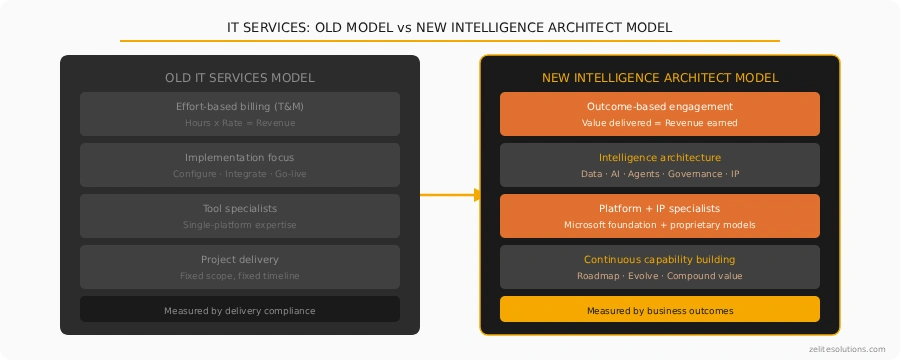
The firms gaining ground are not those who have gotten better at implementation. They are those who have changed what they are selling. From delivering systems to designing intelligence. From project delivery to outcome-based partnership. From being the team that configured the software to being the team that decided what the software should accomplish and built proprietary capability on top of it.
What This Transition Looks LikeOld Model vs. New Model
 What Microsoft Is Making Possible
The Platform Underneath the New Model
Microsoft’s platform — Fabric, Copilot, Dynamics 365, Copilot Studio, Azure AI Foundry — provides the foundation that intelligence architecture is built on top of. Partners who understand how to design and build above this foundation are commanding premium engagements. Partners who only configure components of it are competing on price. The platform is the same. The difference is whether the partner has the capability to use it as a foundation or only as a product.
What Clients Gain From a Different Kind of PartnerThe Client-Side Case for Intelligence Architecture Partners
- AI investments that are defined and measured in business outcome terms — not in project delivery terms
- Architecture that gets more valuable over time rather than depreciating the moment the go-live handover happens
- Proprietary capabilities built on top of the platform that a competitor cannot simply license from Microsoft
- A partner who is accountable for what happens after implementation — not just compliant with the specifications they were given
A Transition We Made Deliberately
We made this transition on purpose — not because we saw the market moving and reacted, but because we decided two years ago that the intelligence architecture model was where durable value lived and invested accordingly. That meant building a practice with genuine AI design capability, not just expanding implementation capacity. It meant building an engagement model around outcomes, not deliverables. And it meant being willing to have harder conversations with clients about what success actually looks like — rather than agreeing to a scope document and calling it done at go-live.
We do not compete with commodity implementation. We build above it. That is a deliberate position.
If You Are Evaluating Technology Partners for Your AI RoadmapThe difference between an implementation partner and an intelligence architecture partner is real, and it becomes visible quickly. If you want to understand what that distinction looks like in practice — not in theory — we are happy to show you.