
Two Very Different Capabilities, One Very Common Mistake
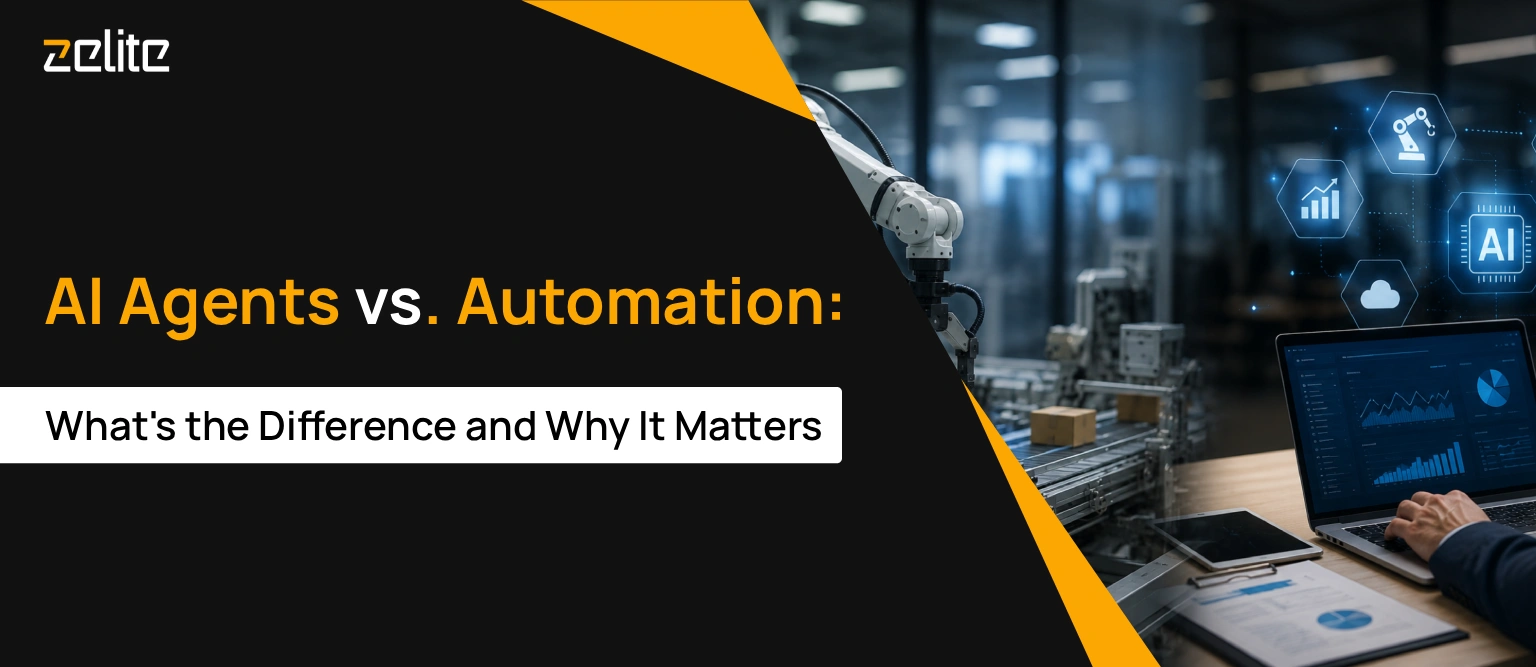
Right now, many enterprise technology decisions are being made by leaders who are using ‘automation’ and ‘AI agents’ interchangeably. They are not the same thing. The distinction matters practically — not as an academic point about definitions — because deploying the wrong capability for a task produces either disappointing results or wasted money. Usually both.
Deploying traditional automation where you need AI agents gives you a system that breaks at the first exception. Deploying agents where automation would suffice costs five times as much and adds complexity you do not need. Getting this distinction right is foundational to any coherent AI investment strategy.
What Automation Is Actually Good AtThe Real Value of RPA and Workflow Tools — and Their Hard Limits
Robotic Process Automation, workflow tools, and rule-based systems have delivered genuine value for a specific category of work: high-volume, structured, predictable tasks. Moving data between systems. Triggering notifications. Processing standard forms. Routing approvals through defined steps. For this category of work, automation is faster, cheaper, and more reliable than agents. It works well — within its intended scope.
The problem is what happens at the edge of that scope. When the input is slightly different. When the exception does not match a rule. When the context changes. Automation breaks. Escalates. Produces wrong outputs. And a human has to intervene at every exception — which, in many business processes, is more often than anyone wants to admit.
What Agents Handle That Automation CannotA Different Category, Not a Better Version
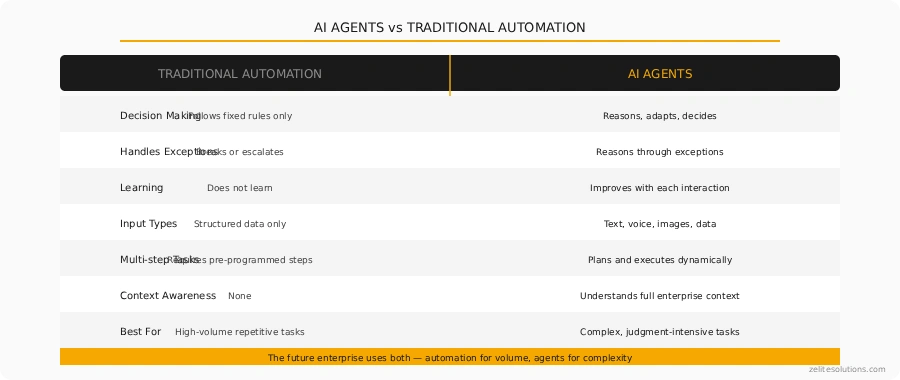
AI agents are not improved automation. They are a different category of capability. Automation follows rules. Agents reason. Automation breaks at exceptions. Agents handle them — because they can understand context, apply judgment, and plan a response rather than looking up an answer. Automation requires a human to define every step in advance. Agents plan their own steps based on a goal. Automation processes structured data. Agents work with text, voice, images, tables, and ambiguous inputs. The use cases are genuinely different.
Comparing the Two Side by SideWhere Each Capability Belongs
 The Microsoft Approach to Both
Power Automate and Copilot Studio: Complementary, Not Competing
Microsoft Power Automate handles traditional automation — data movement, form processing, system integration, scheduled workflows. Microsoft Copilot Studio handles AI agents — context-aware, multi-step, reasoning-capable work that requires judgment. These are not competing products. They are designed to work together in a layered architecture: Power Automate handles the structured, predictable execution layer. Copilot Studio agents handle the reasoning, decision, and exception layer on top of it.
Most real enterprise workflows need both. The structured steps run through Power Automate. The judgment steps — what to do when the contract terms are non-standard, or the customer request does not match a defined category — go to an agent. Getting that division right is the architecture work that determines whether the whole system is reliable.
Matching Capability to TaskThe Decision Framework That Actually Matters
- High-volume, structured, predictable tasks belong in Power Automate — it is faster, cheaper, and more reliable than agents for exactly this category of work
- Exception handling and complex reasoning belong to agents — they handle what automation was never designed for, and they reduce the human escalation overhead that makes complex processes expensive to run
- Hybrid workflows — automation for the structured steps, agents for the judgment steps — are the most common architecture in real deployments, and also the most effective
- Full replacement of routine cognitive labor is where agents earn their cost — the use case where neither automation nor humans alone is the right answer
Use the Right Tool. Not the Impressive One.
We do not advocate for agents over automation or automation over agents. We design the architecture that fits the task. Power Automate where it is sufficient. Agents where reasoning is required. Both, combined, where the workflow needs layers. The goal is not to use the most sophisticated technology. It is to use the right technology — and then actually measure whether it is working.
That last part — measuring whether it is working — is something a lot of AI investments skip. It should not be optional.
If You Are Not Sure Whether Your Workflow Needs Automation or an Agent
That is a ten-minute conversation. Describe the workflow, the current exception rate, and the decisions that currently require a human — and the answer becomes clear fairly quickly. Let us have that conversation.