
The Boardroom Question That Changed Everything
Boards Don’t Want AI Strategy – They Want P&L Impact
Boards have stopped asking “Are you doing AI?” and started asking “What is AI doing for our P&L?” That’s a fundamentally different question, and most technology teams aren’t prepared to answer it well. They can show deployment numbers and adoption rates. What boards want to see is a line from AI investment to revenue growth, cost reduction, or margin improvement. If you can’t draw that line clearly, the AI budget is at risk.
This blog is about making that case – in the language boards and CFOs actually use
The Problem With AI Adoption Metrics
AI Metrics That Don’t Connect to Business Value
Most AI investment reports to boards focus on adoption metrics: Copilot seats activated, automations deployed, projects in progress. These numbers are easy to produce and genuinely insufficient. A board member who asks “Is AI working?” and receives a slide showing usage rates has not had their question answered. The question behind the question is always: “What is this doing to our financials?”
A Simple Framework for Real Business Value
Three Tiers of Real Business Value
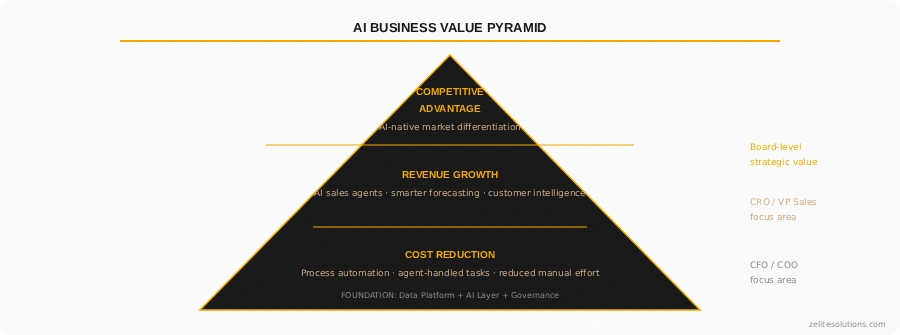
The value pyramid shows three tiers of AI business impact. At the base: cost reduction and efficiency – the most immediate, measurable benefits and where most organizations see ROI first. In the middle: revenue growth — from AI-enhanced sales performance, faster customer response, and better market timing. At the top: competitive advantage – the long-term differentiation that builds as your AI capabilities develop in ways competitors can’t quickly replicate. Most organizations only capture the base tier. The real prize is making it up the pyramid.
How AI Creates Financial Value
The Three Ways AI Creates Financial Value
AI creates financial value in three distinct ways, and they interact. Efficiency gains – making existing work faster and cheaper – fund further investment. Revenue improvements from better sales and customer engagement increase the top line. And capability advantages that competitors can’t easily replicate change the competitive position. The organizations that capture all three don’t just reduce costs — they reshape their competitive position.
What Microsoft Actually Delivers Across the Value Tiers
What Each Part of the Microsoft Stack Actually Delivers
Copilot and Power Automate are your efficiency layer – tasks faster, manual effort reduced, cognitive overhead shifted to agents. This is real and measurable, but it’s also available to every competitor with a Microsoft agreement. Dynamics 365 AI and sales agents are your revenue layer – better pipeline visibility, faster proposals, smarter customer engagement. Here’s the honest take on the Microsoft stack: the efficiency and revenue tools are strong, but the part most organizations leave untapped is Azure AI Foundry. That’s where you build proprietary intelligence from your own data – the competitive advantage tier that isn’t available off the shelf.
The Metrics That Actually Matter in the Board Deck
The Metrics That Survive a Board Presentation
- Cost reduction: reduction in manual processing time, lower cost per transaction, reduced headcount required for scaling
- Revenue growth: improvement in win rates, shorter sales cycles, higher customer lifetime value
- Efficiency: faster decision cycles, fewer escalations, higher throughput per employee
- Competitive advantage: time-to-market improvement, customer experience differentiation, proprietary intelligence that cannot be purchased
Each metric should be defined at the start of every AI investment – not measured after the fact.
What We Believe About AI Investment
Start With the Business Case, Build to It
Zelite’s engagement model starts with the business value definition – the specific revenue, cost, and efficiency outcomes that will justify the AI investment. Architecture, technology, and delivery decisions all flow from that definition.
When we complete an engagement, we present board-level outcome reports: revenue impact, cost reduction, efficiency improvement, measured against the baseline we established at the start. Not deployment summaries. Outcomes.
Ready to Make the Case to Your Board?
Build the Business Case Before You Build the Technology
Let’s start with your board presentation. What would make your CFO confident that AI investment is justified? Zelite can help you define the specific revenue, cost, and efficiency targets – and build the architecture that gets you there.