

The Institutional Knowledge Problem Nobody Talks About
Think about what your organization has learned in the last decade. The proposals that won major deals — and the ones that lost, and why. The project decisions that worked and the ones that didn’t. The customer relationships your best people understand in ways that took years to build. The engineering choices that reflect deep accumulated expertise. That knowledge exists. The question is whether it dies when the people who hold it walk out the door — or whether you’ve built a way to preserve and use it.
For most organizations, almost none of this knowledge is accessible to AI — or honestly, to most people. It sits in SharePoint folders that keyword search can barely navigate. In email threads accessible only to the people on them. In meeting recordings nobody has ever reviewed. And in the memories of experienced employees who will eventually leave and take those memories with them.
Why Document Organization Doesn’t Solve the ProblemWhy Organizing Documents Better Doesn’t Help
Every organization we talk to has tried to solve this with better document organization. SharePoint governance projects. Metadata schemas. Intranet portals. These investments are real, but they consistently underdeliver. The reason is structural: organizing documents for human navigation is a completely different problem from making knowledge accessible to AI. Humans browse and search by keywords. AI needs semantic meaning — the ability to find conceptually relevant content even when the exact words don’t match.
From Storing Documents to Activating KnowledgeMaking Knowledge Findable by Both Humans and AI
 The Architecture That Makes Knowledge AI-Ready
How the Architecture Actually Works
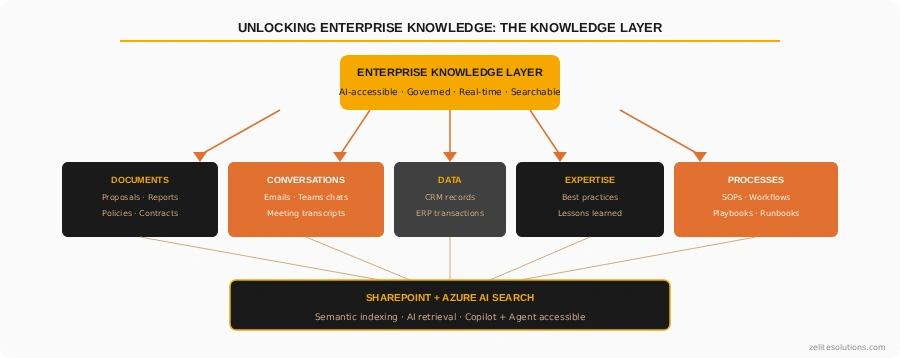
A knowledge intelligence architecture has five source layers: documents, conversations, data, expertise, and processes. All of these flow through a semantic processing layer — Azure AI Search, embeddings, entity extraction – into a unified knowledge layer that Copilot and custom agents can query in real time. The processing layer is the critical differentiator. It converts your documents from files into meaning – something that can be retrieved with semantic accuracy that keyword search can’t touch.
SharePoint + Azure AI: What the Combination Actually DoesWhat the Microsoft Combination Unlocks
SharePoint, connected to Azure AI Search and Copilot, becomes a genuine knowledge intelligence layer. SharePoint holds the documents — that part most organizations have. Azure AI Search provides the semantic indexing that most organizations haven’t configured. Copilot makes the knowledge accessible through natural language. Here’s what surprises most clients: the documents don’t need to be reorganized. The semantic layer works on the content as it exists — finding meaning within it rather than requiring it to be restructured first.
Microsoft Fabric connects the operational data layer to the knowledge layer — ensuring AI agents can reason with both documentary knowledge and transactional data simultaneously. This is the combination most organizations are missing.
What Changes When Knowledge Becomes AccessibleThe Business Impact of Accessible Knowledge
- New employees productive faster because institutional knowledge is accessible, not locked in colleagues’ memories
- Proposals built on the best elements of every previous successful proposal — automatically retrieved and surfaced
- Customer service responses informed by the full history of every customer interaction — not just what the agent in front of them knows
- Sales conversations enriched by everything the organization knows about the prospect’s industry, competitors, and decision patterns
- Decisions made with the full benefit of past experience — not just current information
The Most Common Mistake in AI Programs
Knowledge architecture is the part of AI programs that gets the least attention and creates the most problems when ignored. We’ve seen this pattern consistently: organizations invest in AI tools, then discover their agents can’t answer accurately because the knowledge layer wasn’t activated. The most common question we hear is “Why is our Copilot giving wrong answers?” — and the most common answer is that it’s not finding the right content because the knowledge architecture wasn’t built. Every intelligence architecture we design includes a knowledge layer assessment, a classification and indexing strategy, and an AI activation plan. Not as an add-on — as a foundation.
Your Best AI Asset Is Already In Your OrganizationReady to Unlock Your Organization’s Knowledge?
The most valuable AI asset your organization has isn’t a model or a tool – it’s the institutional knowledge your people have built over years of work. Zelite can help you activate it so it doesn’t walk out the door with the people who hold it.