


The SharePoint Reality Nobody Wants to Admit
Your SharePoint Is Huge and Mostly Unfindable
If your organization has been on SharePoint for more than five years, there’s a high probability your SharePoint has become what people quietly call “the place documents go to die.” Search returns 300 results when you need one. Navigation structures were designed by someone who left years ago. New employees learn within a month that SharePoint search is unreliable and start asking colleagues directly. The irony is that the document you need almost certainly exists — it just can’t be found.
AI-powered knowledge management doesn’t solve this by reorganizing your SharePoint. It solves it by fundamentally changing how knowledge is retrieved.
Why Taxonomy Projects Always Disappoint
The Governance Approach That Only Works Until It Doesn’t
The standard response to this problem is taxonomy: build better classification structures, enforce metadata schemas, create navigation hierarchies. This makes intuitive sense. It almost never works at scale. With thousands of documents being created across hundreds of contributors, taxonomy governance falls apart within a year. Documents land in the wrong folders. Metadata fields get left blank. The structure that looked clean in the pilot looks like chaos 18 months in. We’ve seen this cycle at nearly every client who attempted a traditional SharePoint governance project.
Semantic Search Changes Everything
What Changes When AI Understands Meaning, Not Just Words
How the Knowledge Processing Stack Works
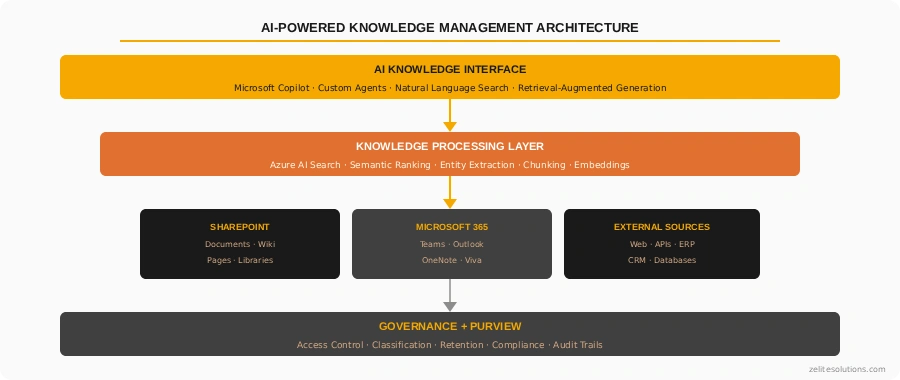
Under the Hood: How AI Knowledge Management Works
The AI knowledge management stack processes documents through four layers: chunking (breaking documents into semantically coherent segments that preserve meaning), embedding (converting text into vector representations that capture conceptual similarity, not just matching words), indexing (storing those embeddings in a searchable vector database), and retrieval (finding the most semantically relevant content for any query, even when the exact words don’t match). The critical thing to understand: this works on your content as it already exists. You don’t need to reorganize SharePoint first.
Azure AI Search provides all four layers. Connected to SharePoint and Microsoft 365, it transforms your existing document repository into a semantic knowledge base. Copilot and custom agents can then query it in natural language.
The Microsoft Knowledge Intelligence Stack — Honestly Assessed
The Right Combination – and the Part Most Organizations Skip
SharePoint is the document repository — you already have it. Azure AI Search is the semantic processing layer — this is the piece most organizations haven’t built yet, and it’s where the transformation happens. Copilot is the natural language interface that lets any employee query the knowledge base through conversation. Copilot Studio agents retrieve specific knowledge on demand, surfacing the right procedure, the right policy, or the right precedent exactly when it’s needed. Microsoft Purview governs the whole layer — ensuring access controls and sensitivity classifications apply consistently. The combination is powerful. Azure AI Search is the most underused piece of the stack.
What Happens When Knowledge Actually Works
The Real Payoff: Knowledge That Works at Scale
- Employees answer questions in seconds instead of searching for minutes or asking colleagues
- New hire onboarding time reduced as institutional knowledge becomes self-service
- Customer service quality improved as agents access the full knowledge base in real time
- Sales win rates improved as proposals leverage best practices from previous successful bids
- Compliance risk reduced as the latest policies and procedures are always accessible and applied
These are not incremental improvements. They represent a fundamental shift in how knowledge creates value.
What We’ve Learned About Knowledge Architecture
Treat Knowledge Architecture as a Strategic Investment
We’ve seen organizations spend months on SharePoint cleanup projects before starting AI work — reorganizing folders, enforcing metadata, cleaning up permissions — only to discover that the AI activation didn’t need the cleanup. The semantic layer works on the content as it exists. That said, there are cases where specific knowledge is genuinely missing or too unstructured even for AI to interpret. Our job is to tell you which is which. We design the indexing strategy, build the Azure AI Search integration, activate Copilot knowledge capabilities, and deploy agents for the workflows where knowledge retrieval creates the most value.
Turn Your SharePoint Into Something People Actually Use
Make Your SharePoint Investment Worth What You Paid
Your SharePoint investment deserves to do more than store files. Zelite can assess your current knowledge architecture, design the AI activation plan, and build the integration that makes it a genuine competitive asset.