
Recognizing the Shift Is Not the Same as Navigating It
Spend ten minutes in any Microsoft partner briefing and you will hear the word ‘platform’ used constantly. Yet the majority of enterprises using Microsoft are not operating a platform — they are running a collection of licenses. Copilot for some users, Dynamics for the CRM team, maybe a Fabric pilot somewhere in data. None of it connected, none of it working as a system.
Where the Tool-by-Tool Approach Breaks DownIndividual Tools That Cannot See Each Other
When AI investments happen tool by tool, each one optimizes for its own use case in isolation. Copilot helps individuals work faster. A chatbot handles some queries. A model produces reports nobody quite trusts. None of them talk to each other — and something that could be called intelligence never actually emerges. You end up with productivity tools stacked on top of each other, which is not the same thing as a smarter organization.
Microsoft Has Already Answered This — Most Partners Have Not Caught UpThree Layers That Actually Work Together
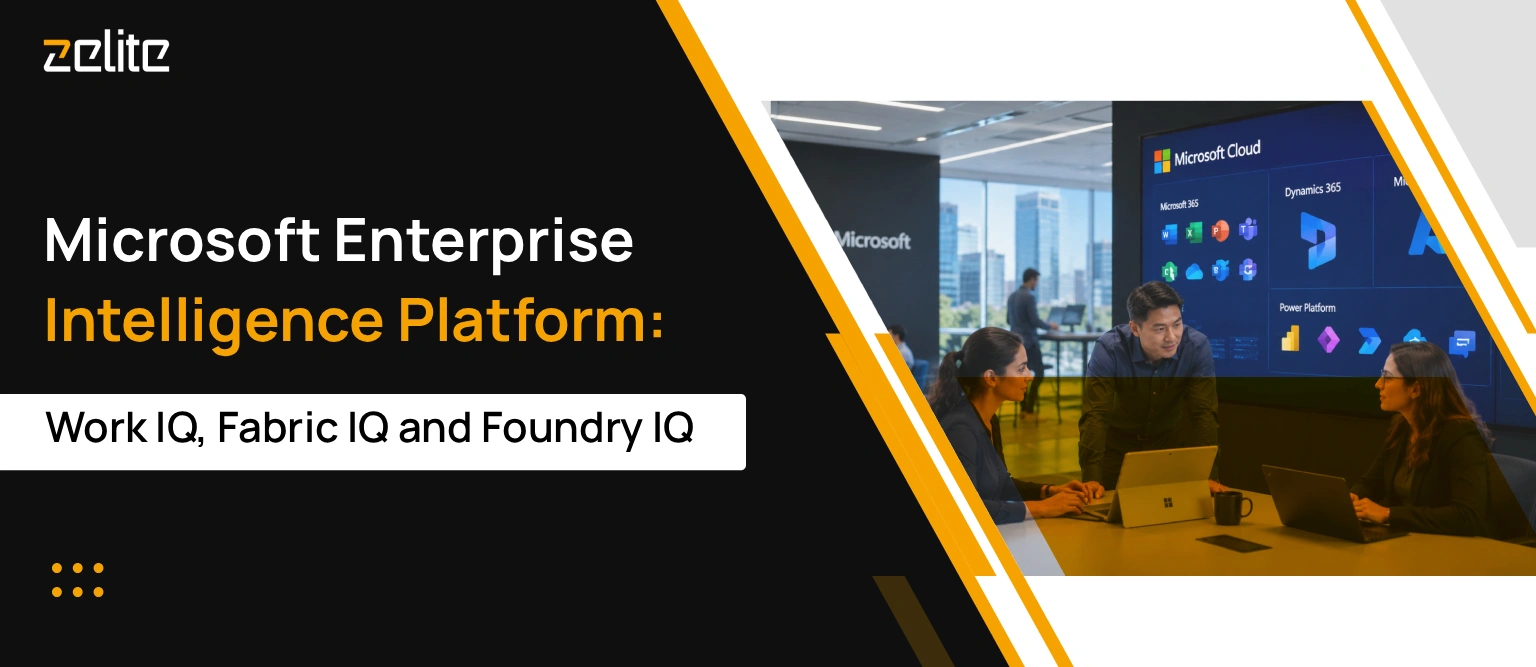
Microsoft has mapped out a coherent answer through three integrated layers — Work IQ, Fabric IQ, and Foundry IQ. This framing is genuinely useful, and underused. Most conversations about Microsoft AI still center on Copilot, which is one part of Work IQ — one layer of a three-layer system. The organizations treating it as the whole picture are leaving most of the value on the table.
How the Three Layers Work in PracticeWork IQ + Fabric IQ + Foundry IQ: The Full Picture
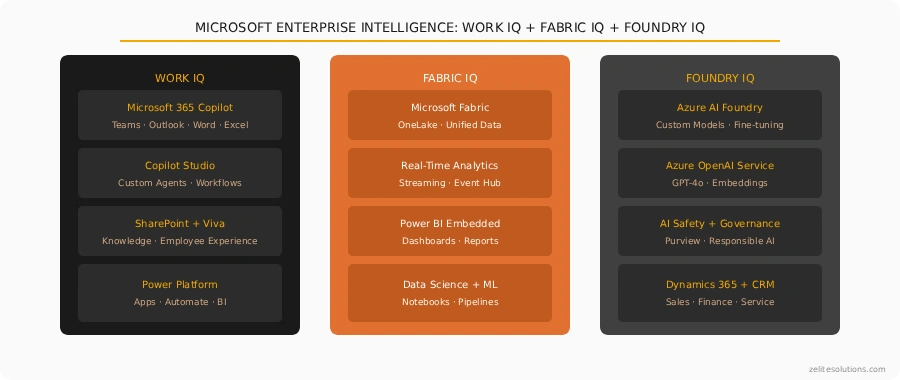
Work IQ makes every employee more capable through ambient AI. Fabric IQ unifies the data that AI reasons over. Foundry IQ is where organizations build capabilities no vendor catalog can provide. Each layer depends on the others — which is the point. You can deploy all three independently and get partial value. Or you can connect them and get something qualitatively different.
 What Each Layer Actually Does
Unpacking Work IQ, Fabric IQ, and Foundry IQ
Work IQ is Microsoft 365 Copilot, Copilot Studio, SharePoint, and Power Platform — the layer that puts AI in front of every employee in the tools they already use every day. Fabric IQ is Microsoft Fabric and OneLake — the unified data foundation that makes AI trustworthy, because every system is reasoning from the same version of reality. Foundry IQ, built on Azure AI Foundry and Azure OpenAI, is where organizations build intelligence that is genuinely proprietary. Nobody can buy your Foundry-built models off a Microsoft price list — that is the differentiator.
What Happens When All Three Work TogetherThe System Effect
When all three layers operate as a connected system, something shifts. Copilot gets more accurate because it is drawing on Fabric-unified data rather than whatever happens to be cached nearby. Agents become genuinely reliable because they are reasoning over a consistent data layer. And the proprietary models built in Foundry continuously make the Work IQ layer smarter over time. The value is not additive — it is multiplicative. That distinction matters when you are trying to justify the investment.
What We Have Seen Work — and What Has NotConnecting the Layers Is the Hard Part :
The most common mistake we see is organizations treating the three IQ layers as a shopping list rather than an architecture. They buy Copilot, add Fabric later, and file Foundry under ‘future roadmap’ with no clear plan for how they connect. The result is three separate investments that never produce the system effect. We help clients design the connections from the start — not as a future project, but as part of the initial architecture.
If Your Microsoft Investment Is Not Behaving Like a Platform Yet
Most organizations that have been investing in Microsoft for years already have the pieces. What they are missing is the architecture that connects them. That is a much shorter path to value than starting from scratch — and it is the conversation we most enjoy having.