
Why AI Output Quality Is a Data Quality Problem
Ask any team that has deployed AI and then quietly stopped using the outputs. The reason is almost never the model. The reason is data. Siloed systems feeding the model conflicting information. Duplicate records producing recommendations that make no sense. Ungoverned pipelines delivering stale data to a system that has no way of knowing it is stale. The AI looks bad. The model gets blamed. The real problem was upstream.
Siloed systems, inconsistent formats, duplicate records, ungoverned pipelines — these are not edge cases in enterprise data environments. They are the norm. Any organization deploying AI on top of this situation is building on a foundation that was not designed for the job.
Why the Previous Solutions Did Not Solve ThisData Warehouses and Data Lakes Both Miss the Point
The standard responses to data fragmentation — data warehouses, data lakes, data lakehouses — delivered real value but did not solve the fundamental problem. They all require data to move before it can be used. Movement creates latency. It creates new inconsistencies at the point of transfer. It creates cost. And it creates governance complexity because you now have to maintain multiple copies of the same data with different update cycles. The AI still ends up reasoning over something that is not quite current, not quite complete, not quite trustworthy.
A Different Architecture EntirelyOne Lake, Everywhere Data Lives
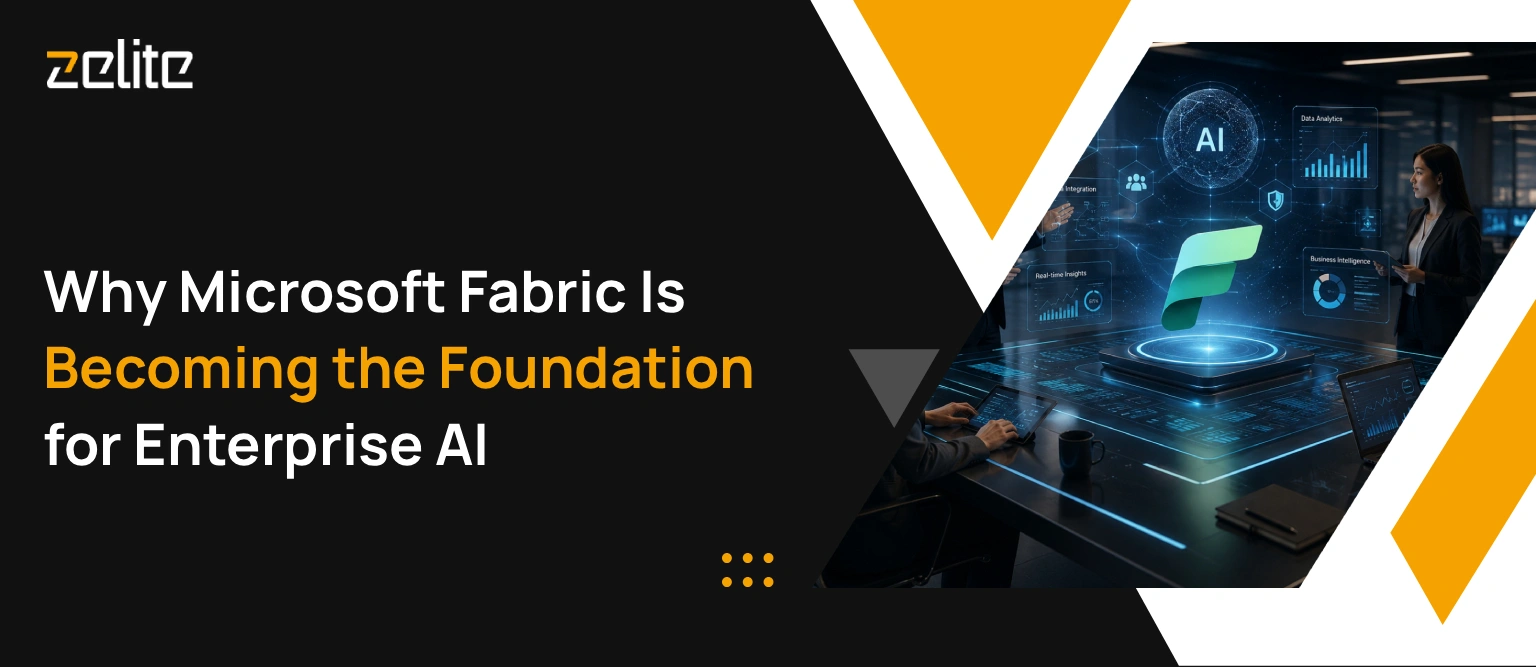
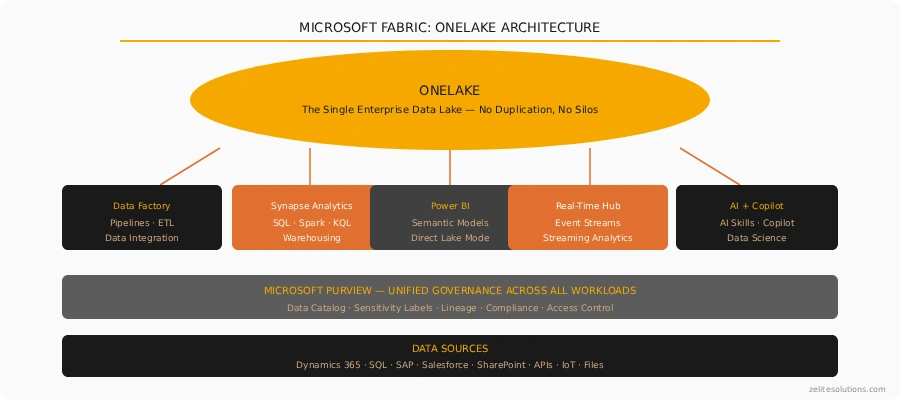
Microsoft Fabric’s OneLake architecture takes a different approach. Instead of moving data to a central repository, OneLake creates a unified logical view of all enterprise data — wherever it physically lives — with a consistent governance and access layer over everything. Data stays where it is. Every system that needs it accesses it through the same interface. Governance is enforced at the data layer, once, rather than replicated across every tool that touches the data.
What OneLake Actually Looks LikeThe Architecture in Practice
OneLake sits at the center. Every Fabric workload — Data Factory, Synapse Analytics, Power BI, Real-Time Hub, AI Skills — accesses the same underlying data through a consistent interface. Purview handles governance and compliance across all workloads simultaneously. Nothing is duplicated. Nothing is out of sync. If your mental model for this is still ‘a better data warehouse,’ it is worth updating — OneLake is architecturally different from what came before it.
 Where Fabric Fits in the Broader Microsoft Ecosystem
The Data Foundation Under Everything Else
Fabric connects to every Microsoft enterprise system — Dynamics 365, SharePoint, Azure, Microsoft 365 — and to external systems through its connector ecosystem. This is underappreciated: Fabric is not a standalone analytics product. It is the data foundation that makes everything else work better. Every Copilot interaction becomes more accurate. Every agent becomes more reliable. Every report stops requiring reconciliation. The value of Fabric is not in what it does on its own — it is in what it enables everything else to do.
What Becomes PossibleThe Practical Difference a Unified Data Foundation Makes
- AI models that actually produce outputs teams trust — because they are reasoning over clean, governed data rather than whatever happens to be accessible
- Copilot responses that are genuinely current — not drawing from cached information that was accurate three weeks ago
- Agents that can query financial, operational, and customer data simultaneously without requiring custom integration work for every new capability
- Reports that teams stop arguing about — because every visualization draws from the same source, not four slightly different ones
- Governance enforced at the data layer before any AI system touches it — which is the only approach that actually scales
Start Here, Not With the AI Tool
Here is something we say to clients that sometimes surprises them: we start with Fabric, not with Copilot or agents. Not because Fabric is the flashiest investment — it is not — but because it is the most important one. Every AI capability we build for clients works better, is more trustworthy, and delivers more consistent value when it is grounded in a Fabric architecture built for AI from the start. The organizations that skip this step and jump straight to AI tools eventually come back to fix the data foundation anyway. Better to build it correctly the first time.
The single most valuable thing most enterprises can do before their next AI investment is not buy another AI tool. It is unify their data.
If Your AI Outputs Are Not Consistent Enough to Trust
The issue is almost certainly data, not the model. Zelite can assess your current data architecture and design a Fabric foundation that makes your next AI investment significantly more effective than your last one.