
A Decade of Chatbot Deployments — and Not Much to Show for It
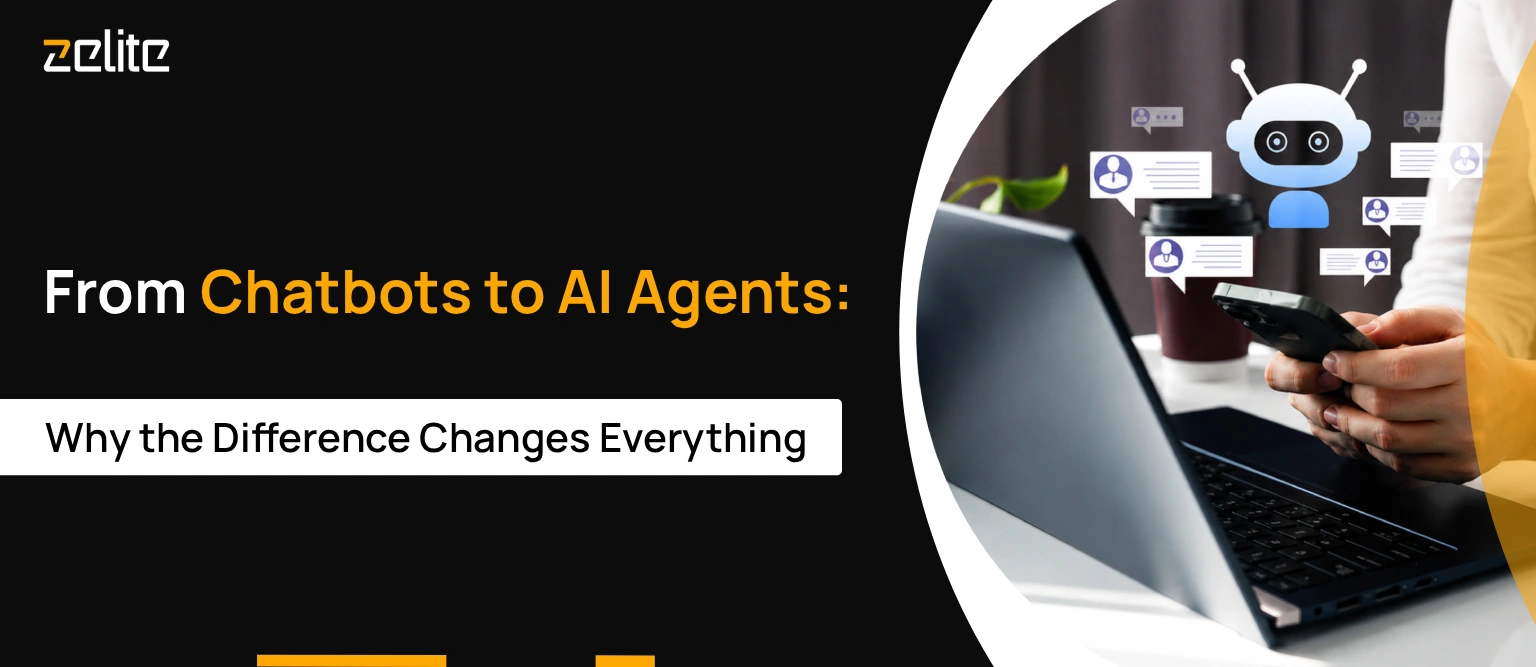
Most enterprises have tried chatbots. They answer scripted FAQs, route support tickets, respond predictably to common questions, and collapse the moment a conversation goes anywhere unexpected. After a decade of quiet accumulation, enterprise chatbot deployments have consistently underdelivered — not because the idea was bad, but because chatbots were architecturally limited from the start. The era of chatbots is not just declining. For forward-looking organizations, it is already over.
The gap between what a chatbot does and what AI agents do is not incremental. It is structural. And the difference has direct implications for where enterprise AI investment belongs now. What Makes Chatbots Architecturally LimitedResponding Is Not the Same as Reasoning
Chatbots are designed to respond — not to reason. They match what you typed to a pattern, then return the nearest pre-written answer. They have no memory of what happened in previous conversations. They cannot look up live enterprise data. They cannot take action in any connected system. They are, at their core, a sophisticated lookup table. That is a fair use case for simple, stable, scripted interactions. It is not useful for anything that requires judgment, exceptions handling, or taking action on behalf of the user.
What Agents Actually ArePerceive, Reason, Act, Learn
AI agents are not better chatbots. They are a different category. Agents perceive context — reading not just the question you asked, but what the relevant enterprise data says about the situation. They reason — working through options, applying business logic, planning a multi-step response. They act — updating records, triggering workflows, sending notifications, calling APIs. And they learn — improving from each interaction so that future responses are better than past ones. You might be wondering if this is still theoretical. It is not. This is production capability today on Microsoft Copilot Studio.
Seeing the ContrastChatbots vs. Agents: The Architecture Difference
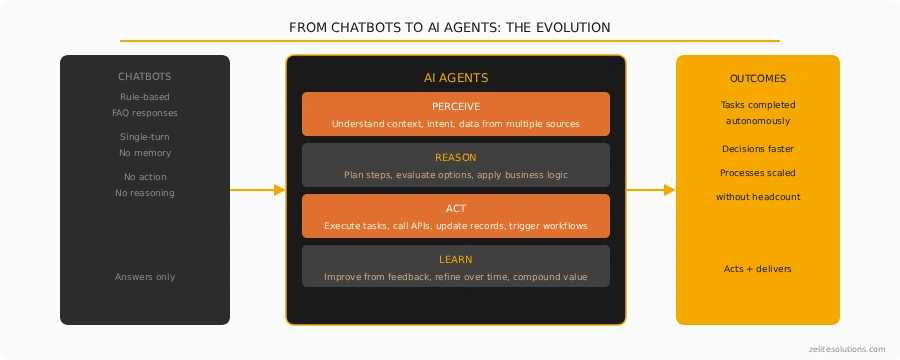
The contrast in the diagram is not subtle. Chatbots are rule-based, single-turn, stateless, and action-free. Agents perceive context from multiple live sources, reason through complexity, act in connected enterprise systems, and improve over time. These are not different versions of the same thing. They are different categories of capability serving different categories of work.
Where Microsoft FitsBuilding Agents on the Microsoft Platform
Microsoft Copilot Studio is the primary platform for building, deploying, and governing AI agents in the Microsoft ecosystem. Agents connect to Dynamics 365 to read and write CRM and ERP data. They access SharePoint for knowledge retrieval — not static FAQs, but live institutional knowledge. They query Microsoft Fabric for analytical context when they need to reason about data, not just retrieve it. And they operate within Purview governance frameworks that define what each agent is permitted to do and what it is not. That last piece matters more than most people realize — ungoverned agents are a risk, not a feature.
What Agents Can Do That Chatbots Simply CannotThe Practical Business Difference
- Multi-step task completion without requiring human approval at every step — an agent that can research, draft, submit, and confirm without constant intervention
- Actions in connected systems — updating CRM records, sending communications, triggering approval workflows — not just answering a question and waiting
- Responses grounded in live enterprise data rather than static training content from six months ago
- Genuine improvement over time as agents learn from feedback and from outcome signals
- Faster resolution, higher accuracy, and lower cost per interaction — the metrics that justify the investment
The Honest Difference Between Chatbots and Agents in Practice
We have built and deployed AI agents on the Microsoft platform across sales, operations, finance, and customer service. The consistent pattern: agents that were designed with a clear scope, governed boundaries, and a measurable outcome target deliver. Agents that were designed to look impressive in a demo usually do not survive contact with a real business process. The architecture matters, but so does the discipline around defining what the agent is actually trying to accomplish — and what happens when it cannot.
If Your Chatbots Are Not Delivering and You Are Ready to Move On
Most organizations that have tried chatbots know where they failed. Agents address those structural limitations directly. If you want to talk through what a real agent deployment looks like for your specific use case, that is a short conversation worth having.