
Stop Asking Whether AI Will Replace Workers. Start Asking This Instead.
For three years, the enterprise conversation about AI and the workforce has circled the same anxious question: will AI replace human jobs? It is the wrong question. Not because job displacement is not real — some of it is — but because organizations fixated on that question are missing the more important and more immediately actionable one: how should human and AI capabilities be structured together to create the most effective organization?
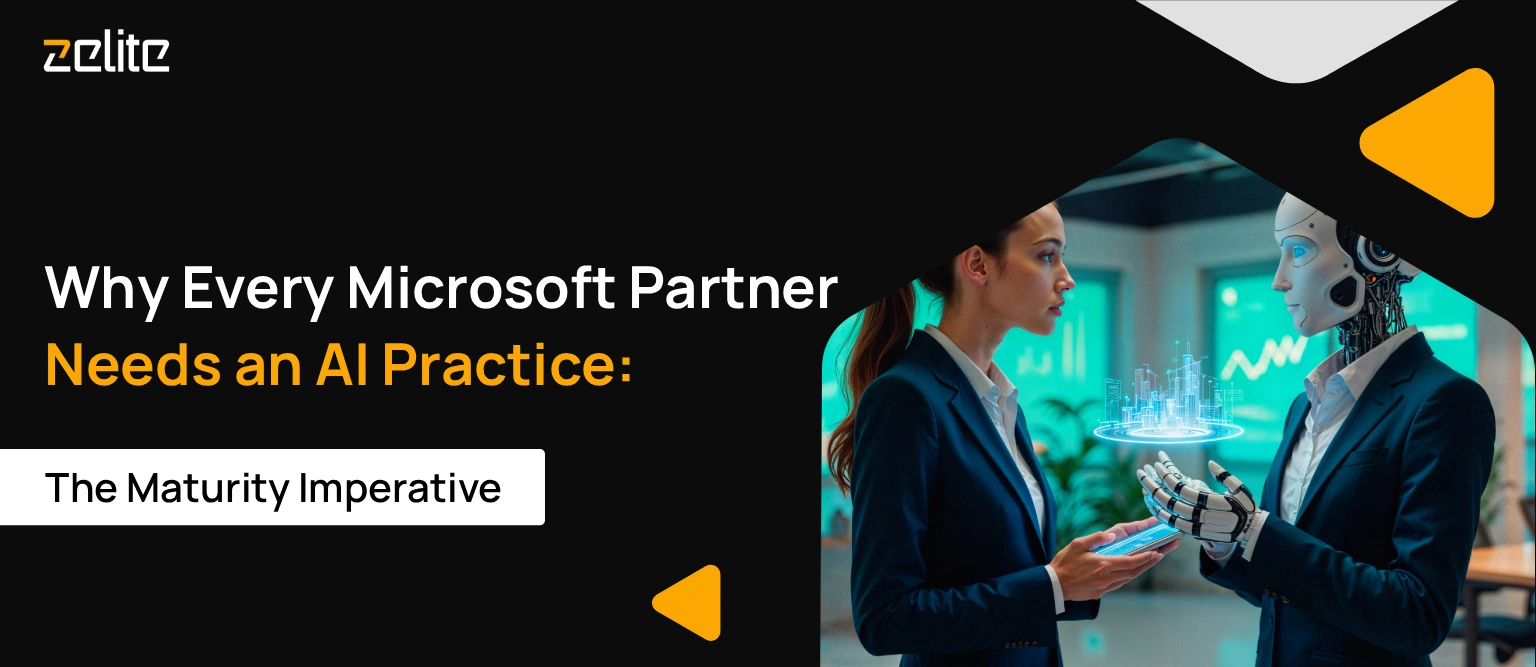
The organizations getting this right are not building AI to replace people. They are redesigning work so that humans spend their time on what humans are uniquely good at — and agents handle everything else.
Why Treating AI as a Tool Creates an Artificial Ceiling
Tools Do Not Plan. Agents Do.When AI is positioned as a tool — something a human operates to get a task done — its potential is structurally limited. Tools respond to instruction. They do not plan. They do not delegate. They do not get better from one use to the next. AI agents do all three. Treating an agent like a tool is like hiring a capable person and only letting them answer specific questions when asked. You are paying for the capability but not using it.
Redesigning Work, Not Just Adding AIWhat Human-Agent Collaboration Actually Looks Like
The emerging model does not start by asking which human tasks AI can automate. It starts with a different question: which tasks genuinely benefit from human judgment, creativity, or relationship — and which do not? For the tasks that do, you want humans. For the tasks that do not, you want agents. This sounds simple. In practice it requires a real redesign of roles and workflows — and that redesign is organizational work, not just technology work.
What the Architecture Looks LikeHumans and Agents, Each Doing What They Do Best
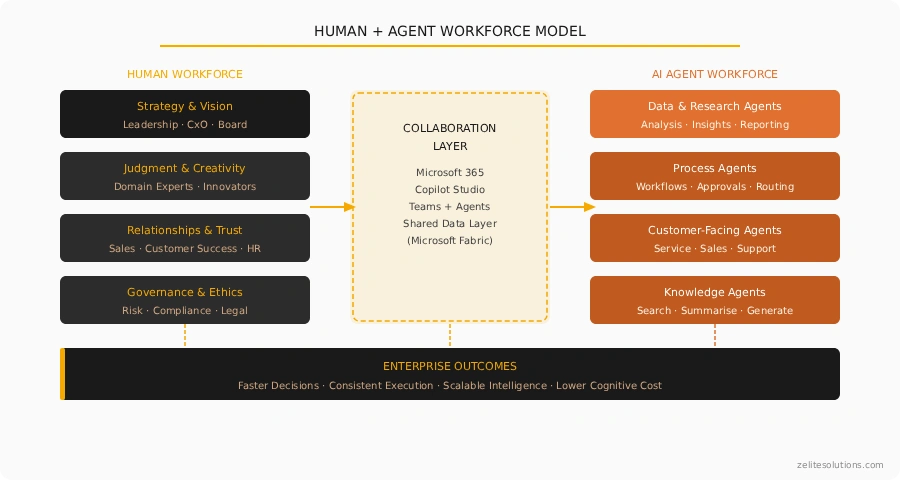
In the model that works, humans are focused on strategy, judgment, relationships, and governance — the work where being human matters. Agents handle data retrieval, process execution, routine customer interactions, and knowledge retrieval — the work where speed, consistency, and availability matter more than human judgment. Both operate through a shared platform layer: Microsoft 365, Copilot Studio, Fabric, and Teams. The coordination happens in the tools everyone is already using.
The Microsoft Platform for This ModelWhere Teams, Copilot, and Agents Work Together
Microsoft Copilot makes AI ambient in every tool employees use — so the collaboration between human and agent is not a separate interface people have to learn, it is present in Teams, in Outlook, in the productivity tools already open on every screen. Copilot Studio provides the platform for creating agents with defined roles and governed capabilities — workforce members with a scope, not tools that can do anything. Microsoft Teams becomes the coordination layer where humans and agents work alongside each other. Fabric provides the shared data foundation that ensures humans and agents are reasoning from the same version of reality — which turns out to matter a great deal when agents are making decisions that humans then act on.
What Actually Changes When This Is WorkingThe Organizational Outcomes
- Human employees shift exclusively toward high-judgment, high-relationship, and high-creativity work — the work that genuinely benefits from a human being present
- Agents handle routine cognitive tasks without requiring headcount to scale with volume
- Decision quality improves because agents surface better information faster than manual research would
- Organizational capacity expands without proportional cost expansion — which is the economic case that actually gets executive attention
- Employee satisfaction tends to improve as the administrative burden that nobody wanted shifts to agents
The Organizational Work That Technology Cannot Do For You
The technology for this exists today. The harder work is the organizational design: deciding which roles should be redesigned around agent collaboration, which tasks should be delegated, and how the collaboration model should be structured for your specific industry and operating model. That work requires someone who understands both the technology and the organizational reality — and who is willing to have honest conversations about what will and will not work in your specific context.
If Your Organization Is Ready to Move Beyond AI Productivity Tools
Redesigning how work happens in an organization is real change management, not just a software project. If you are ready to do that work, the conversation starts with which roles would look different if agents were handling the right parts of them.