


Two Very Different Capabilities, One Very Common Mistake
AI Adoption Is Concentrated in the Wrong PlacesWhile IT and Marketing Got Copilot, Everyone Else Is Still Waiting
Walk into most enterprises and you will find that AI adoption is concentrated in two or three departments — typically IT, data science, or marketing — while finance, operations, HR, legal, and sales are watching from the sidelines. This uneven adoption is not just an efficiency problem. It creates a growing skepticism among the functions that are not seeing results: if AI is so transformative, why has it not touched my work yet? The answer, usually, is that nobody built anything for their specific function.
Why Generic AI Tools Do Not Serve Specific FunctionsHorizontal AI and Vertical AI Are Not the Same Thing
Generic AI tools — Copilot for productivity, analytics platforms for dashboards — provide broad value that benefits everyone equally and differentiates no one specifically. They are designed to be useful everywhere, which means they are not optimized for anywhere in particular. The real value in agents is vertical: purpose-built for specific functions, connected to function-specific data, governed by function-specific rules. A sales agent that understands your deal stages is fundamentally different from a general-purpose assistant that can talk about sales.
Every Function Needs Its Own AgentPurpose-Built Is Better Than General-Purpose
The model that works is one where every business function has purpose-built agents handling the routine cognitive work of that function — freeing people to focus on judgment, relationships, and strategy. Not the same agent deployed everywhere with slightly different prompts. Specialized agents designed for the specific data, workflows, compliance requirements, and performance metrics of each function. The architecture is more complex. The outcomes are significantly better.
What This Looks Like Across the BusinessAgents for Every Function
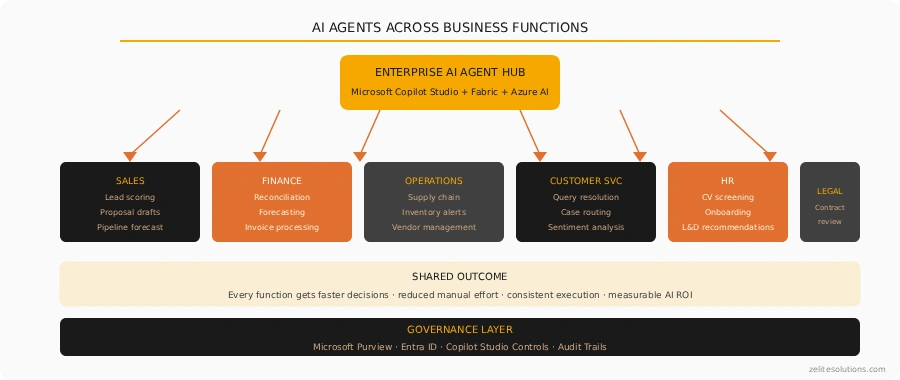 How Microsoft Enables Function-Specific Deployment
The Platform Under Every Agent
Copilot Studio is the development platform for function-specific agents. Each agent connects to the relevant Microsoft system: Dynamics 365 for sales and service data, Business Central for finance, Power Platform for operations workflows. Fabric provides the unified data layer that ensures every agent is drawing from the same underlying source of truth. And Purview ensures each agent operates within its defined boundary — which matters particularly in functions like finance and legal where governance is not optional.
What This Looks Like Function by FunctionThe Practical Outcomes by Department
- Sales: Response time to new leads drops from hours to minutes. Proposals get drafted with accurate product and pricing data. CRM records update automatically. The rep who used to spend forty percent of their time on administrative work now spends most of it selling.
- Finance: Reconciliation that used to take days happens continuously. Forecasting runs against real-time data rather than last month’s export. Human review is reserved for exceptions rather than every transaction.
- Operations: Inventory agents monitor stock levels and flag potential shortages before they become production delays.
- Procurement agents compare vendor options against current pricing and contract terms. People get alerted to problems they would previously have discovered too late.
- Customer Service: Routine queries get resolved in seconds. Complex escalations arrive with full context already compiled — not starting from scratch with an irritated customer.
- HR: Candidate screening happens faster and more consistently. Employees can get answers to policy questions without waiting for an HR rep. Learning recommendations surface based on actual role requirements, not general courses.
- Legal: Contract review agents flag non-standard clauses before anyone signs anything. Compliance agents monitor continuously rather than catching issues in annual audits.
Build for the Function, Not for the Organization
The mistake to avoid is building one general-purpose agent and deploying it everywhere. That produces an agent that is mediocre at everything and excellent at nothing. What we build for clients is function-specific agents that understand the specific data, logic, and governance requirements of their domain. They are harder to build and significantly more valuable to use. The question we start with for every function is the same: what is the routine cognitive work that does not actually benefit from a human being the one to do it?
Which Function in Your Business Is Most Ready for Its Own Agent?
The answer is usually obvious once you spend twenty minutes mapping the routine cognitive work in each department. We can help you run that exercise — and turn the answer into an agent deployment plan with a clear ROI case.